QUICK FACTS
Born: August 6, 1809 · Somersby, Lincolnshire, England
Died: October 6, 1892 · Lurgashall, Sussex, England (aged 83)
Era: Victorian
Occupation: Poet; Poet Laureate (1850–1892)
Education: Trinity College, Cambridge
Known for: In Memoriam A.H.H., “Ulysses,” “The Charge of the Light Brigade”
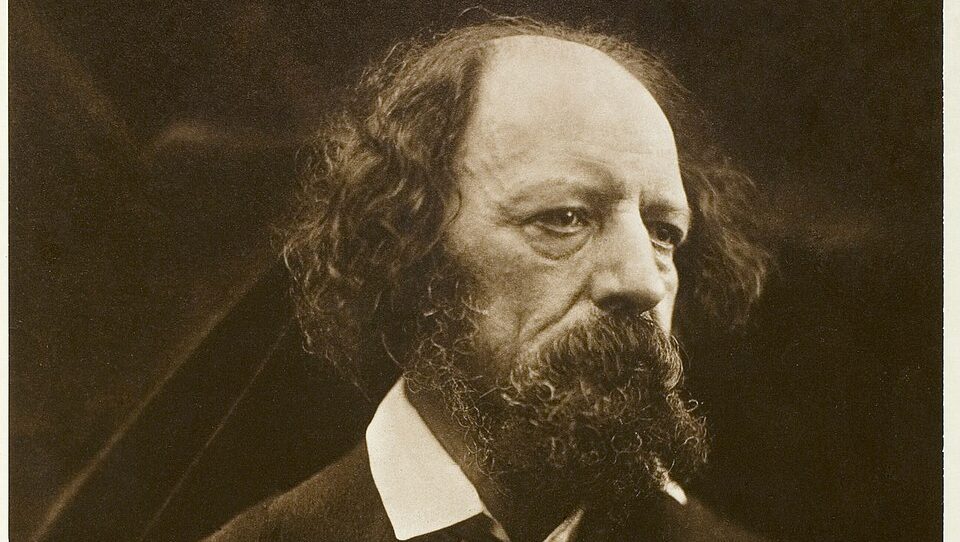
Alfred Tennyson (1809–1892) was the leading poet of the Victorian age and, for more than forty years, its Poet Laureate. Renowned for the music of his verse and the depth of his feeling, he gave the era some of its most quoted lines and captured both its confidence and its deep uncertainties.
From the long elegy In Memoriam A.H.H. to the stirring narrative of “The Charge of the Light Brigade,” Tennyson moved easily between private grief and public occasion. His work wrestles with love, loss, and the collision of faith and science — the central anxieties of a changing century.
On This Page: Early Life and Education · Literary Career and Major Works · Style and Themes · Later Life and Legacy · Notable Poems · Frequently Asked Questions · Related Poets
Early Life and Education
Tennyson was born on August 6, 1809, into a large, bookish family in rural Lincolnshire, where his father served as rector. He began writing verse as a boy and, while still a student, published a volume with two of his brothers.
At Trinity College, Cambridge, he joined the brilliant circle known as the “Apostles” and formed a profound friendship with Arthur Henry Hallam. Hallam’s sudden death in 1833, at only twenty-two, devastated Tennyson and became the wellspring of much of his greatest poetry.
He left Cambridge without a degree after his own father’s death, returning home to a long period of financial hardship and obscurity.
Literary Career and Major Works
Tennyson’s rise from neglect to national fame took two decades. His early collections drew uneven notice, and a round of harsh reviews drove him into a long, near-silent retreat. He re-emerged with the two-volume Poems (1842), which contained “Ulysses,” “Locksley Hall,” and “Break, Break, Break” and finally secured his reputation.
The breakthrough came in 1850: he published In Memoriam A.H.H., the vast elegy for Hallam that became one of the century’s defining poems; married Emily Sellwood; and succeeded Wordsworth as Poet Laureate. As laureate he wrote for the nation — “The Charge of the Light Brigade” (1854) and the Arthurian epic Idylls of the King — while never losing his lyric gift.
Style and Themes
No Victorian matched Tennyson’s command of sound. His verse is famous for its musicality — the careful weighting of vowels and consonants that makes lines linger in the ear — and for imagery of unusual richness and precision.
His great themes are love and loss, time and mortality, and above all the struggle to keep faith in an age unsettled by science and doubt; In Memoriam confronts that crisis head-on. He was at once the public voice of his era and a private, melancholy lyricist, and the tension between those two roles gives his best work its depth.
Later Life and Legacy
Honors gathered around Tennyson as he aged. Wealth and fame came at last, and he lived his final decades as the most celebrated poet in England. In 1884, he was raised to the peerage as Baron Tennyson — the first writer so honored for his work alone — and he kept publishing almost to the end, closing with the serene “Crossing the Bar” (1889), which he asked to be placed last in every edition of his poems.
He died on October 6, 1892, at eighty-three, and was buried in Poets’ Corner in Westminster Abbey. Though later critics sometimes found his moral confidence dated, his craftsmanship and humanity have kept him at the center of English poetry.
Notable Poems
These are the Tennyson poems most worth starting with:
- Ulysses: A dramatic monologue in which an aging Ulysses refuses to rest, vowing “to strive, to seek, to find, and not to yield.”
- In Memoriam A.H.H.: His monumental elegy for Arthur Hallam — a years-long meditation on grief, faith, and doubt.
- The Charge of the Light Brigade: A thundering ballad memorializing a doomed but heroic cavalry charge in the Crimean War.
- The Lady of Shalott: A spellbinding Arthurian ballad of a cursed woman who dies for love of Lancelot.
- Break, Break, Break: A short, aching lyric of loss set against the indifferent breaking of the sea.
- Crossing the Bar: His calm, valedictory poem that imagines death as a putting-out to sea, written near the end of his life.
Frequently Asked Questions
Quick answers to the questions readers most often ask about Alfred Tennyson.
What is Alfred Tennyson best known for?
Being the leading poet of the Victorian age and its Poet Laureate for over forty years, and for works such as In Memoriam A.H.H., “Ulysses,” and “The Charge of the Light Brigade.”
Was Tennyson Poet Laureate?
Yes. He succeeded Wordsworth as Poet Laureate in 1850 and held the post until his death in 1892 — the longest tenure of any laureate.
What is In Memoriam A.H.H.?
Tennyson’s long elegy, published in 1850, for his close friend Arthur Henry Hallam, who died in 1833. Across many short sections it wrestles with grief, faith, and the doubts raised by science.
What are the main themes in Tennyson’s poetry?
Love and loss, time and mortality, heroism and duty, and the Victorian struggle to reconcile religious faith with scientific doubt.
Why is Tennyson called “Lord Tennyson”?
In 1884 he was raised to the peerage as Baron Tennyson — the first English writer ennobled for his literary work — which is why he is often called Lord Tennyson.
Related Poets
Readers who admire Tennyson often turn to these poets:
- Robert Browning: His great Victorian contemporary and the other master of the dramatic monologue.
- Matthew Arnold: A fellow Victorian who wrestled with the same crisis of faith, in a more austere, elegiac key.
- Elizabeth Barrett Browning: A leading Victorian poet whose passionate lyricism complements Tennyson’s music.
- John Keats: The Romantic forebear whose lush musicality Tennyson openly inherited and refined.
- Gerard Manley Hopkins: A Victorian innovator who pushed the music of English verse in a radically different direction.