QUICK FACTS
Born: December 24, 1822 · Laleham, England
Died: April 15, 1888 · Liverpool, England (aged 65)
Era: Victorian
Occupation: Poet, cultural critic, school inspector
Education: Balliol College, Oxford
Known for: “Dover Beach,” The Scholar-Gipsy, Thyrsis, Culture and Anarchy
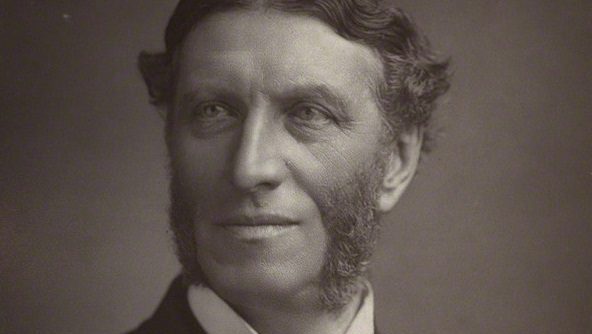
Matthew Arnold (1822–1888) was an English poet and cultural critic whose reflective, melancholy verse gave voice to the spiritual uncertainty of the Victorian age. Best known for “Dover Beach,” he ranks among the major poets of the period — and, unusually, holds an equal place in its history as a literary and social critic.
Writing in an era unsettled by scientific discovery and waning religious certainty, Arnold sought a middle ground between faith and reason, emotion and intellect. His poetry turns again and again to isolation, lost belief, and the search for calm in a restless world, while his prose argued that culture — “the best that has been thought and said” — could steady a society in flux.
On This Page: Early Life and Education · Literary Career and Major Works · Style and Themes · Later Life and Legacy · Notable Poems · Frequently Asked Questions · Related Poets
Early Life and Education
Arnold was born on December 24, 1822, in Laleham, Middlesex, the eldest son of Dr. Thomas Arnold, the famous reforming headmaster of Rugby School, and Mary Penrose Arnold. He grew up in a household that prized moral seriousness alongside learning.
After schooling at Winchester and then Rugby under his father, he went up to Balliol College, Oxford, where he won the Newdigate Prize for poetry in 1843 and absorbed the classical literature and theological debate that would shape his life’s work.
Following graduation he worked briefly as a private secretary before his 1851 appointment as an inspector of schools — a demanding post he would hold for more than three decades, and one that carried him across England and the Continent.
Literary Career and Major Works
Arnold’s poetic career opened quietly. His first collections, The Strayed Reveller, and Other Poems (1849) and Empedocles on Etna, and Other Poems (1852), drew little notice but already circled his lifelong subjects: spiritual alienation and the longing for wholeness.
Recognition came with Poems (1853), which gathered “The Scholar-Gipsy” and announced a poet of unusual gravity. His elegy “Thyrsis,” written for his friend Arthur Hugh Clough, and the meditative “Dover Beach” (published 1867) became his most enduring poems; the latter’s image of faith’s “melancholy, long, withdrawing roar” remains one of the defining metaphors of modern doubt.
As his verse thinned in the later 1850s, Arnold turned to prose, and as Professor of Poetry at Oxford (1857–1867) and the author of Essays in Criticism (1865) and Culture and Anarchy (1869) he became one of the most influential critics of the century.
Style and Themes
Arnold’s distinctive voice comes from a tension at the heart of his work. His poetry joins Romantic introspection to classical restraint — feeling deeply felt, but disciplined by clarity and order. Drawn to Wordsworth’s moral seriousness and to Greek models of form, he wrote a measured, dignified verse that rarely raises its voice.
The recurring themes are unmistakable: isolation, the erosion of religious faith, the gap between the modern world and the inner life, and the search for consolation in art and human sympathy. That elegiac, questioning tone — more troubled than triumphant — is what marks a poem as distinctly Arnold’s.
Later Life and Legacy
Arnold’s final decades belonged more to the lecture hall than the writing desk. He continued his school inspections and undertook two celebrated lecture tours of the United States, in 1883 and 1886, building a reputation as the “sage” of Victorian humanism.
His poetry had largely fallen silent, but his criticism reached a wide audience and outlived him. He died suddenly of heart failure in Liverpool on April 15, 1888, at sixty-five. His idea of culture as a civilizing force shaped later thinkers from T. S. Eliot to F. R. Leavis and Lionel Trilling, and his call for balance and humane values still speaks to ages of cultural division.
Arnold endures as both a poet of loss and longing and a critic of rare integrity.
Notable Poems
These are the Arnold poems most worth starting with:
- Dover Beach: His best-known poem, a night-time meditation in which the retreating tide becomes an image of faith draining out of the modern world.
- The Scholar-Gipsy: A pastoral elegy following an Oxford student who abandons academic life to wander the countryside in search of deeper truth.
- Thyrsis: A companion piece to The Scholar-Gipsy, written as an elegy for Arnold’s close friend the poet Arthur Hugh Clough.
- Sohrab and Rustum: A tragic narrative poem in the epic manner, in which a great warrior unknowingly kills his own son in single combat.
- The Forsaken Merman: An early narrative lyric in which a merman mourns the human wife who has left the sea to return to her own world.
- The Buried Life: A reflective poem on the hidden inner self that daily life keeps us from knowing — in ourselves and in those we love.
Frequently Asked Questions
Quick answers to the questions readers most often ask about Matthew Arnold.
What is Matthew Arnold best known for?
He is best known for “Dover Beach,” one of the most famous poems of the Victorian era, and for his critical book Culture and Anarchy. Arnold was both a major poet and a leading cultural critic of his day.
Was Matthew Arnold a Romantic or a Victorian poet?
Arnold was a Victorian poet, writing from the 1840s onward, though his work bridges the two traditions: it carries the introspection of Romanticism while voicing the doubt and disillusionment of the Victorian age.
What are the main themes in Matthew Arnold’s poetry?
Isolation, the loss of religious faith, the strain between the modern world and the inner life, and the search for calm and meaning through art and human connection.
When was “Dover Beach” written?
It was published in 1867 in New Poems, though Arnold is thought to have drafted much of it around 1851, near the time of his marriage.
What did Matthew Arnold do besides write poetry?
He spent more than thirty-five years as a government inspector of schools, served as Oxford’s Professor of Poetry (1857–1867), and wrote influential prose on culture, education, and religion.
Related Poets
Readers who admire Arnold often turn to his Victorian contemporaries:
- Alfred Tennyson: The Victorian age’s defining poetic voice, whose “In Memoriam” wrestles with the same crisis of faith.
- Robert Browning: A contemporary master of the dramatic monologue, and a very different temperament — energetic where Arnold is elegiac.
- Thomas Hardy: A later poet who inherited Arnold’s bleak honesty about a universe indifferent to human hope.
- Gerard Manley Hopkins: A Victorian who answered the same religious doubt with radically inventive, faith-driven verse.