QUICK FACTS
Born: May 7, 1812 · Camberwell, London, England
Died: December 12, 1889 · Venice, Italy (aged 77)
Era: Victorian
Occupation: Poet; playwright
Education: Largely self-educated; University of London (briefly)
Known for: “My Last Duchess”; the dramatic monologue; The Ring and the Book
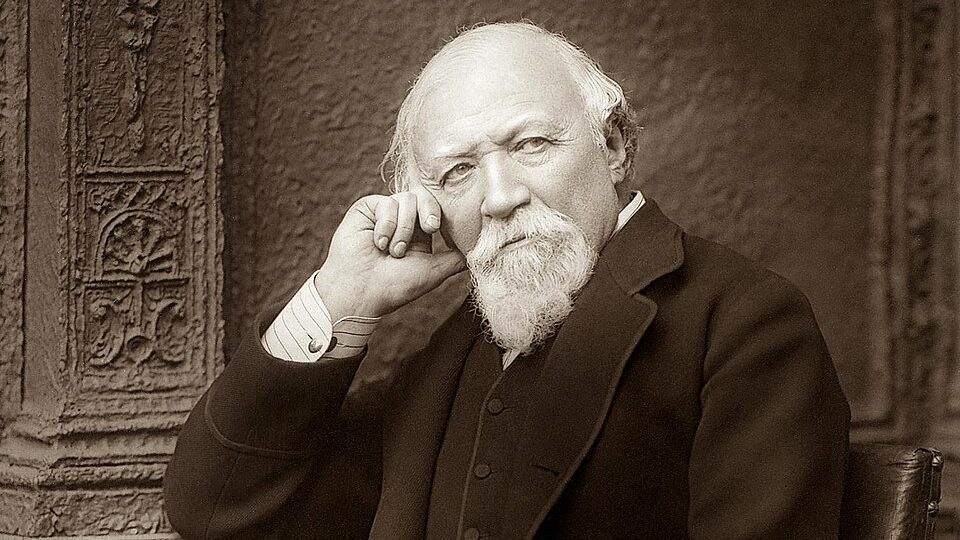
Robert Browning (1812–1889) was one of the foremost poets of the Victorian age and the supreme master of the dramatic monologue — the poem in which a single speaker, talking to a silent listener, unknowingly lays bare his own mind. Browning used the form to explore obsession, vanity, faith, and moral evasion with a psychological depth far ahead of his time.
Difficult and little-read in his early career, Browning rose by its end to be ranked beside Tennyson. His “My Last Duchess” is among the most taught and admired poems in English, and his innovations in voice and character helped open the way to modern poetry.
On This Page: Early Life and Education · Literary Career and Major Works · Style and Themes · Later Life and Legacy · Notable Poems · Frequently Asked Questions · Related Poets
Early Life and Education
Browning was born on May 7, 1812, in Camberwell, then a leafy suburb of London, into a cultured middle-class family. His father was a bank clerk and scholar with a library of thousands of books; his mother was a devout, musical woman.
Largely self-taught in that library, Browning read voraciously, learned several languages, and steeped himself in art, music, and history. He briefly attended the new University of London but soon left, preferring to educate himself and to commit, against more practical advice, to a life of poetry.
Literary Career and Major Works
Browning’s path to fame was long and, at first, discouraging. His early long poems — Pauline (1833), Paracelsus (1835), and the notoriously obscure Sordello (1840) — won him a reputation for difficulty more than greatness.
His genius emerged in shorter compass: Dramatic Lyrics (1842) and Dramatic Romances and Lyrics (1845) introduced the dramatic monologues that would define him, among them “My Last Duchess” and “Porphyria’s Lover,” chilling studies of obsession and control. In 1846, he secretly married the more famous Elizabeth Barrett and moved with her to Italy.
The mature collections Men and Women (1855) and Dramatis Personae (1864) deepened his art, and his vast verse-novel The Ring and the Book (1868–1869) — which retells a Roman murder trial through many conflicting voices — crowned his career.
Style and Themes
Browning’s signature is the speaking voice caught in the act of revealing itself. Where other Victorians sought music and polish, Browning prized energy, argument, and the rough texture of real speech; his lines can be knotty and colloquial, demanding work from the reader.
Through the dramatic monologue he entered the minds of dukes, murderers, painters, and priests, letting each condemn or expose himself in his own words. His great themes are the tangle of human motive, the conflict of faith and doubt, the nature of love, and the impossibility of any single, final view of the truth. That psychological realism made him a crucial forerunner of the Modernists, who claimed him as an ancestor.
Later Life and Legacy
Recognition came fully only in Browning’s last decades.
After Elizabeth’s death in 1861 he returned to London, and there — with The Ring and the Book and the steady reissue of his earlier work — he at last won wide public honor; admirers founded a Browning Society to study him even in his lifetime. He continued to write to the end, publishing his final volume, Asolando, on the very day he died in Venice, December 12, 1889. He was buried in Poets’ Corner in Westminster Abbey.
His legacy is that of a poet of intellect and passion who reshaped what poetry could do with character and voice.
Notable Poems
These are the Browning poems most worth starting with:
- My Last Duchess: His most famous dramatic monologue — a Renaissance duke chillingly reveals his pride and cruelty while showing off a portrait of his dead wife.
- Porphyria’s Lover: A disturbing monologue in which a lover narrates, with eerie calm, the murder of the woman he wishes to possess forever.
- The Pied Piper of Hamelin: His beloved narrative poem for children, retelling the legend of the piper who rids a town of rats — and then takes its children.
- Home-Thoughts, from Abroad: A tender lyric of homesickness for an English spring, opening “Oh, to be in England.”
- Fra Lippo Lippi: A vivid monologue in the voice of a Renaissance painter-monk defending art, the body, and the joy of the world.
- Rabbi Ben Ezra: A meditative poem on age and faith, famous for its opening, “Grow old along with me!”
Frequently Asked Questions
Quick answers to the questions readers most often ask about Robert Browning.
What is Robert Browning best known for?
His mastery of the dramatic monologue, above all “My Last Duchess,” and his huge verse-novel The Ring and the Book. He is regarded as one of the two or three greatest Victorian poets.
What is a dramatic monologue?
A poem spoken entirely by a single character — not the poet — addressing a silent listener at a charged moment, so that the speaker unwittingly reveals his own personality and motives. Browning perfected the form.
What is “My Last Duchess” about?
A monologue in which a Renaissance duke, showing a visitor a portrait of his late wife, gradually betrays that his jealousy and need for control led to her death — all while negotiating his next marriage.
Was Robert Browning married to Elizabeth Barrett Browning?
Yes. He married the poet Elizabeth Barrett in secret in 1846; the couple eloped to Italy and remained together until her death in 1861.
What are the main themes in Browning’s poetry?
The hidden workings of human motive and obsession, the conflict of faith and doubt, love in many forms, and the difficulty of ever knowing the whole truth.
Related Poets
Readers who admire Browning often turn to these poets:
- Elizabeth Barrett Browning: His wife and fellow poet, whose fame first eclipsed and then was matched by his own.
- Alfred Tennyson: His great Victorian contemporary, with whom he shared the summit of the age’s poetry.
- Matthew Arnold: A fellow Victorian whose reflective verse offers a cooler counterpart to Browning’s dramatic energy.
- T. S. Eliot: A Modernist who learned the dramatic voice and the wandering, speaking mind directly from Browning.
- Ezra Pound: A Modernist pioneer who openly claimed Browning’s monologues as a model for his own.