QUICK FACTS
Born: October 31, 1795 · London, England
Died: February 23, 1821 · Rome, Italy (aged 25)
Era: Romanticism
Occupation: Poet (trained as an apothecary-surgeon)
Education: Clarke’s School, Enfield; Guy’s Hospital, London
Known for: “Ode to a Nightingale,” “Ode on a Grecian Urn,” “To Autumn”
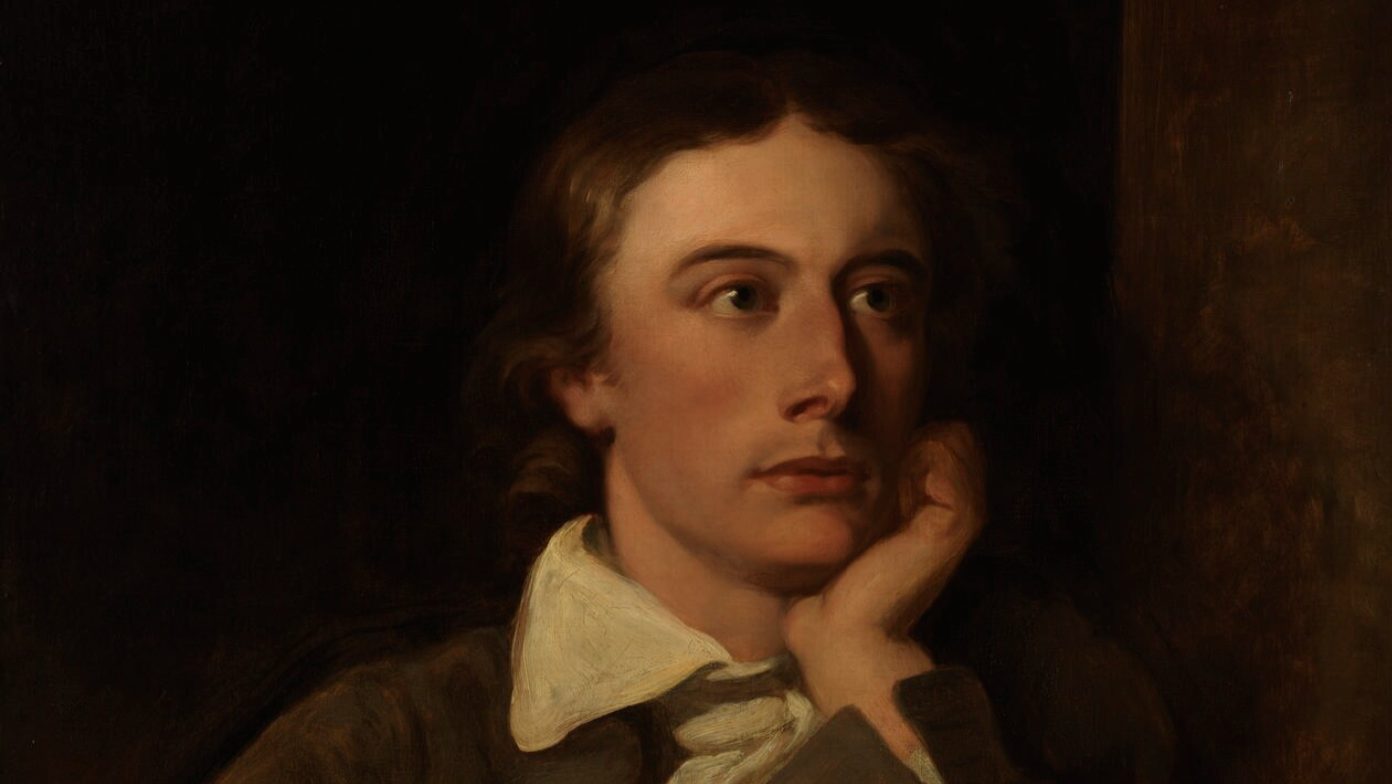
John Keats (1795–1821) was an English Romantic poet whose lush, sensuous verse and meditations on beauty, art, and mortality made him one of the most beloved poets in the language. Though he died at just twenty-five, after barely five years of serious writing, his odes stand among the supreme achievements of English lyric poetry.
Keats pursued beauty as a sacred end in itself — “A thing of beauty is a joy for ever” — yet his work is shadowed throughout by an acute awareness of suffering and decay. That tension between ecstasy and loss, voiced in language of extraordinary richness, is the heart of his enduring appeal.
On This Page: Early Life and Education · Literary Career and Major Works · Style and Themes · Later Life and Legacy · Notable Poems · Frequently Asked Questions · Related Poets
Early Life and Education
Keats was born on October 31, 1795, in London, the eldest child of a livery-stable keeper. Tragedy came early: his father died in a riding accident when Keats was eight, and his mother died of tuberculosis a few years later, leaving the orphaned children in the care of a guardian who had little patience for literary ambition.
At Clarke’s School in Enfield, Keats fell under the spell of Spenser, Shakespeare, and Milton, and discovered what he later called “the genius of poetry.” Apprenticed at fifteen to a surgeon-apothecary and later a medical student at Guy’s Hospital, he qualified to practice in 1816 — then promptly abandoned medicine to commit himself wholly to poetry.
Literary Career and Major Works
Keats’s career was as brief as it was brilliant. His arrival was announced by the 1816 sonnet “On First Looking into Chapman’s Homer,” written in a rush of wonder after a night of reading aloud with a friend.
His first book, Poems (1817), passed almost unnoticed, and the long mythological romance Endymion (1818) was savaged by conservative critics who sneered at him as a member of the “Cockney School.” The attacks did not stop him. In 1819 — his annus mirabilis — he wrote the great odes (“Ode to a Nightingale,” “Ode on a Grecian Urn,” “To Autumn,” and the rest), along with “La Belle Dame sans Merci,” “The Eve of St. Agnes,” and “Hyperion.”
In his remarkable letters of these years, he formulated the idea of “Negative Capability” — the poet’s power to rest in uncertainty and mystery without grasping after fact and reason.
Style and Themes
Keats wrote some of the most physically vivid verse in English. His lines are steeped in taste, color, and texture — honey, wine, cool air — woven so densely that the reader almost touches them. But beneath the sensuous surface runs a constant awareness of impermanence: beauty enchants precisely because it cannot last.
His imagination swings between ecstasy and melancholy, and his great subject is the knot that binds them — pleasure shadowed by loss, art set against time. Where Wordsworth sought moral lessons in nature and Shelley pursued political ideals, Keats made beauty itself the goal: “a joy for ever,” and a refuge against the pain of life.
Later Life and Legacy
Keats’s last years gathered illness, love, and loss together. His brother Tom died of tuberculosis in 1818, and Keats soon showed the same symptoms.
In Hampstead, he fell deeply in love with his neighbour Fanny Brawne — a bond of joy and anguish, since marriage was impossible on his slender means and failing health. In 1820, he published Lamia, Isabella, The Eve of St. Agnes, and Other Poems, containing his masterpieces; the reviews warmed, but too late.
Sent abroad for a milder climate, he sailed to Rome with his friend the painter Joseph Severn and died there on February 23, 1821, at twenty-five. His tombstone bears no name, only the epitaph he chose: “Here lies one whose name was writ in water.” The prophecy proved false — his reputation rose steadily through the century, and he is now counted among the greatest of all English poets.
Notable Poems
These are the Keats poems most worth starting with:
- Ode to a Nightingale: A rapturous flight toward the bird’s deathless song, and the longing to escape mortality through beauty.
- Ode on a Grecian Urn: A meditation on art and permanence that closes on the famous lines binding beauty to truth.
- To Autumn: His last great ode — a serene, sensuous acceptance of ripeness, harvest, and gentle decline.
- La Belle Dame sans Merci: A haunting ballad of a knight bewitched and then abandoned by a fairy woman.
- The Eve of St. Agnes: A richly painted medieval romance of young lovers escaping into a winter night.
- On First Looking into Chapman’s Homer: The breakthrough sonnet capturing the thrill of discovery on first reading Homer in translation.
Frequently Asked Questions
Quick answers to the questions readers most often ask about John Keats.
What is John Keats best known for?
His odes of 1819 — especially “Ode to a Nightingale,” “Ode on a Grecian Urn,” and “To Autumn” — and for being one of the central poets of English Romanticism, despite dying at only twenty-five.
How did John Keats die?
He died of tuberculosis in Rome on February 23, 1821, at the age of twenty-five, having traveled to Italy in the hope that a warmer climate would ease the disease.
What is Negative Capability?
Keats’s famous idea, from his letters, that the finest writers can remain “in uncertainties, mysteries, doubts, without any irritable reaching after fact and reason” — resting in mystery rather than forcing a resolution.
What are the main themes in Keats’s poetry?
Beauty and its impermanence, art versus time, love, nature, and the nearness of death — pleasure always shadowed by loss.
What is written on John Keats’s gravestone?
At his own request, his gravestone in Rome bears no name — only the line “Here lies one whose name was writ in water.”
Related Poets
Readers who admire Keats often turn to these poets:
- Percy Bysshe Shelley: A fellow second-generation Romantic and friend who mourned Keats in his great elegy “Adonais.”
- Lord Byron: The third of the younger Romantics — celebrated and worldly where Keats was inward and sensuous.
- William Wordsworth: The elder Romantic whose nature poetry Keats admired and measured himself against.
- Alfred Tennyson: A Victorian heir whose lush musicality owes an open debt to Keats.
- Christina Rossetti: A later poet whose sensuous, melancholy lyrics carry Keats’s spirit into the Victorian age.