QUICK FACTS
Born: April 7, 1770 · Cockermouth, England
Died: April 23, 1850 · Rydal Mount, England (aged 80)
Era: Romanticism
Occupation: Poet; Poet Laureate (1843–1850)
Education: St John’s College, Cambridge
Known for: Lyrical Ballads, “Tintern Abbey,” The Prelude
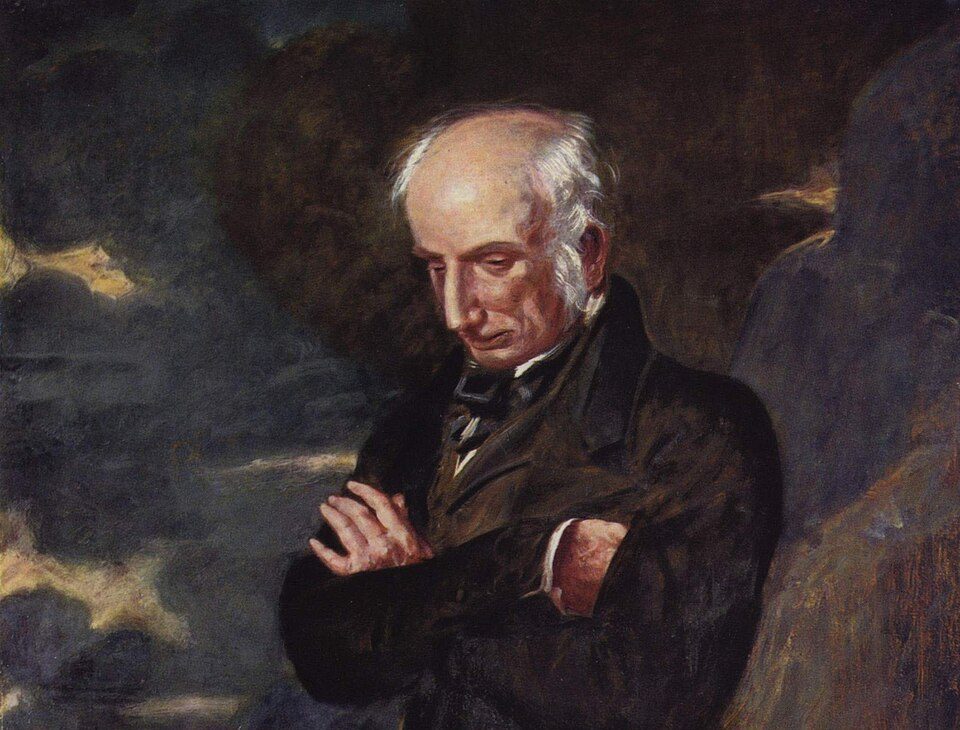
William Wordsworth (1770–1850) was an English poet who, more than anyone, launched the Romantic movement in English literature. His conviction that poetry should be written in the plain language of ordinary people and rise from deep feeling — “the spontaneous overflow of powerful feelings” — overturned the polished conventions of the eighteenth century and reset the course of English verse.
A poet of the Lake District above all, Wordsworth found in nature a moral and spiritual teacher, and in memory and childhood the roots of the adult self. From the revolutionary Lyrical Ballads to the lifelong autobiographical epic The Prelude, his work made the inner life and the natural world the central subjects of modern poetry.
On This Page: Early Life and Education · Literary Career and Major Works · Style and Themes · Later Life and Legacy · Notable Poems · Frequently Asked Questions · Related Poets
Early Life and Education
Wordsworth was born on April 7, 1770, in Cockermouth, on the edge of England’s Lake District — the landscape that would shape his imagination for life.
Orphaned young (his mother died when he was eight, his father when he was thirteen), he was sent among relatives but took his deepest comfort in the hills and lakes around him. He went up to St John’s College, Cambridge, and after graduating walked through Revolutionary France and the Alps, journeys that fired his early political idealism.
His enthusiasm for the French Revolution’s promise of liberty later curdled into disillusionment as the Terror unfolded — a crisis of conscience that echoes through his mature work.
Literary Career and Major Works
Wordsworth’s breakthrough came from a friendship. In the 1790s, he settled near Samuel Taylor Coleridge, and together the two produced Lyrical Ballads (1798), the book usually taken to mark the start of English Romanticism. Opening with Coleridge’s “The Rime of the Ancient Mariner” and closing with Wordsworth’s “Tintern Abbey,” it announced a new poetry of common speech and ordinary life, and its 1800 preface became Romanticism’s manifesto.
Settling at Dove Cottage in Grasmere with his devoted sister Dorothy, Wordsworth entered his greatest decade, producing the “Lucy” poems, “Ode: Intimations of Immortality,” and much of The Prelude — the vast autobiographical poem, published only after his death, that traces “the growth of a poet’s mind.”
Style and Themes
Wordsworth defined poetry as “emotion recollected in tranquillity.” He stripped away the ornate diction of his predecessors in favor of clear, natural language, insisting that the feelings of shepherds and children were fit subjects for serious verse.
Nature is his great theme — not as mere scenery but as a living moral presence that shapes and consoles the human spirit. Memory, childhood, and the workings of his own mind run alongside it; again and again he returns to how early experience forms the adult self. Beneath the calm surface lies a quiet spirituality, a sense of the sacred glimpsed in ordinary things.
Later Life and Legacy
Wordsworth grew more conservative — and more honored — with age. His politics and style both settled into orthodoxy in later decades, and some readers feel his finest work was behind him, but his standing only rose.
In 1843, he was made Poet Laureate, and he died at Rydal Mount on April 23, 1850, at eighty; The Prelude appeared months later. His revolution proved permanent: by returning poetry to natural speech and the inner life, he opened the way for nearly everything that followed, from the Victorians to the moderns.
He remains the founding poet of English Romanticism and the great poet of nature and memory.
Notable Poems
These are the Wordsworth poems most worth starting with:
- Lines Composed a Few Miles above Tintern Abbey: A meditation on memory and nature’s lasting power to console, written on returning to the Wye valley after five years.
- Ode: Intimations of Immortality: His great philosophical ode on childhood, memory, and the fading “celestial light” of early life.
- I Wandered Lonely as a Cloud: His most beloved lyric — the “daffodils” poem — on a memory of golden flowers that returns as joy in solitude.
- The Prelude: His book-length autobiographical epic tracing the growth of his own poetic mind, published after his death.
- The Solitary Reaper: A lyric capturing a Highland girl’s song so haunting that it lingers long after its words are lost.
- She Dwelt among the Untrodden Ways: One of the “Lucy” poems — a spare, aching elegy for an obscure girl whose death goes almost unnoticed by the world.
Frequently Asked Questions
Quick answers to the questions readers most often ask about William Wordsworth.
What is William Wordsworth best known for?
Founding English Romanticism with Lyrical Ballads (1798), co-written with Coleridge, and for nature poems such as “Tintern Abbey” and “I Wandered Lonely as a Cloud” (the daffodils poem).
What is Lyrical Ballads?
The 1798 collection by Wordsworth and Coleridge, usually regarded as the starting point of English Romanticism. Its preface argued that poetry should be written in the real language of ordinary people.
What are the main themes in Wordsworth’s poetry?
Nature as a moral and spiritual force, memory, childhood, the growth of the self, and the value of ordinary life and common speech.
Was William Wordsworth Poet Laureate?
Yes. He was appointed Poet Laureate of the United Kingdom in 1843 and held the role until his death in 1850.
What is The Prelude?
Wordsworth’s book-length autobiographical poem tracing “the growth of a poet’s mind.” He worked on it for decades, and it was published shortly after his death in 1850.
Related Poets
Readers who admire Wordsworth often turn to these poets:
- Samuel Taylor Coleridge: His close collaborator on Lyrical Ballads and fellow founder of English Romanticism.
- John Keats: A second-generation Romantic whose odes carry forward Wordsworth’s faith in feeling and the imagination.
- Percy Bysshe Shelley: A younger Romantic, more radical and visionary, who both admired and pushed against Wordsworth.
- Lord Byron: The most famous of the Romantics, temperamentally Wordsworth’s opposite — worldly and satirical where Wordsworth is meditative.
- Robert Frost: A later poet of rural life and plain speech who inherited Wordsworth’s instinct to find depth in ordinary scenes.