Percy Bysshe Shelley (1792–1822) was an English Romantic poet best known for “Ozymandias,” “Ode to the West Wind,” “To a Skylark” and the verse drama Prometheus Unbound. Expelled from Oxford for atheism and shunned for his politics and private life, he spent his last four years in Italy writing most of his major work. He drowned off the Italian coast in 1822, a month before his 30th birthday, and was married to Mary Shelley, the author of Frankenstein.
The Victorians remembered Shelley as a dreamy lyric poet, “a beautiful and ineffectual angel” in Matthew Arnold’s phrase. That picture leaves out half the man. The poet of the skylark was also the author of a protest ballad written in fury after a massacre, and he believed poetry could change the world. His best lyrics are political, and his politics are lyrical.
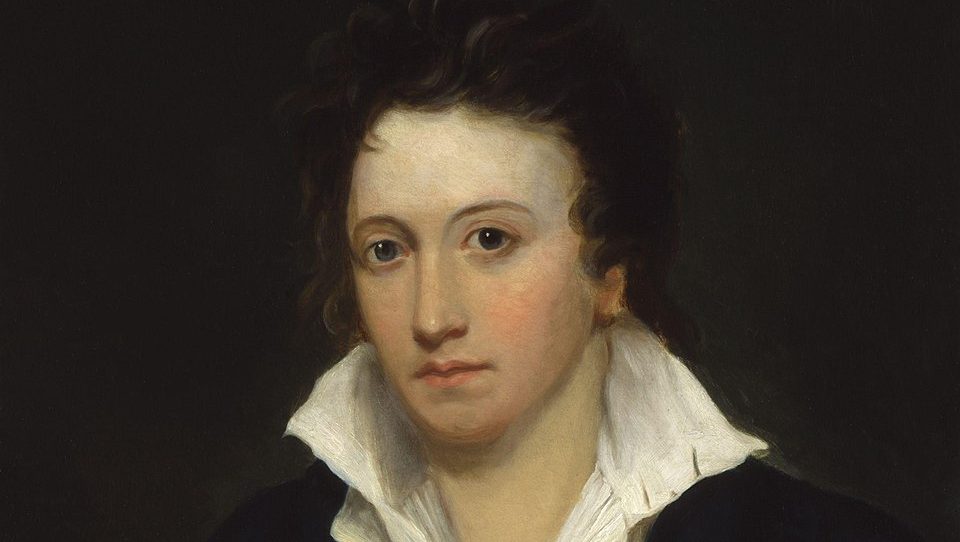
At a Glance
- Born
- 4 August 1792, Field Place, near Horsham, Sussex, England
- Died
- 8 July 1822 (aged 29), Gulf of La Spezia, Italy
- Pronounced
- PUR-see BISH SHEL-ee
- Era
- Romantic
- Known for
- “Ozymandias” (1818), “Ode to the West Wind” (1820), “To a Skylark” (1820), Prometheus Unbound (1820)
- Education
- Eton College; University College, Oxford (expelled 1811)
- Occupation
- Poet, dramatist, essayist
- Spouses
- Harriet Westbrook (married 1811, d. 1816); Mary Wollstonecraft Godwin, later Mary Shelley (married 1816)
- Buried
- Protestant Cemetery, Rome
ON THIS PAGE
Why He Matters · Timeline · Life and Career · Poetry and Style · Famous Poems and Books · Legacy · FAQ
Related Poets
Why Percy Bysshe Shelley Matters
Shelley wrote some of the most quoted lines in English, from “Look on my Works, ye Mighty, and despair!” to “If Winter comes, can Spring be far behind?” He also wrote the most radical poetry of his generation. He attacked kings, priests, war, marriage laws and the treatment of the poor, and he did it in verse of astonishing speed and music. No other English poet of his time put so much beauty to work for so much anger.
His ideas travelled further than his fame. The Mask of Anarchy, written after the Peterloo Massacre of 1819, is one of the first great poems of nonviolent mass protest, and its refrain, “Ye are many, they are few,” has been taken up by protest movements ever since. His essay A Defence of Poetry ends with one of the boldest claims ever made for the art: “Poets are the unacknowledged legislators of the world.”
Percy Bysshe Shelley Timeline
- 1792
- Percy Bysshe Shelley is born on 4 August at Field Place, Sussex, the eldest son of Timothy Shelley, a Whig member of Parliament.
- 1802
- Sent to Syon House Academy, near London.
- 1804
- Enters Eton College, where he is badly bullied.
- 1810
- Publishes the Gothic novel Zastrozzi and goes up to University College, Oxford, in October.
- 1811
- Expelled from Oxford on 25 March over the pamphlet The Necessity of Atheism. Marries 16-year-old Harriet Westbrook in Edinburgh on 28 August.
- 1812
- Campaigns in Dublin for Irish rights and becomes a vegetarian.
- 1813
- Prints his first long poem, Queen Mab, and the essay A Vindication of Natural Diet.
- 1814
- Leaves Harriet and elopes to the Continent with Mary Godwin on 28 July.
- 1816
- Publishes Alastor. Spends the summer on Lake Geneva with Lord Byron, where Mary begins Frankenstein. Harriet drowns in December, and Shelley marries Mary on 30 December.
- 1817
- The Court of Chancery denies him custody of his two children by Harriet. Writes “Ozymandias” at Marlow.
- 1818
- “Ozymandias” appears in The Examiner on 11 January. Leaves England for Italy on 12 March and never returns. His daughter Clara dies in Venice in September.
- 1819
- His son William dies in Rome in June. Writes The Mask of Anarchy after Peterloo, “Ode to the West Wind” and The Cenci. His son Percy Florence is born on 12 November.
- 1820
- Publishes Prometheus Unbound, with “Ode to the West Wind” and “To a Skylark” in the same volume.
- 1821
- Publishes Epipsychidion and Adonais, his elegy for John Keats. Writes A Defence of Poetry.
- 1822
- Publishes Hellas. Drowns on 8 July when his boat sinks in a storm; he is cremated on the beach near Viareggio on 16 August.
- 1824
- Mary Shelley publishes his Posthumous Poems.
- 1832
- The Mask of Anarchy is finally published.
- 1840
- A Defence of Poetry is published.
Life and Career
Shelley lived only 29 years, and nearly all his major poetry comes from the last five. His life moved fast, broke rules at every turn and left grief behind it, and his poems cannot be separated from it.
A Rebel Heir (1792–1811)
Shelley was born into wealth and expectation at Field Place in Sussex. His father was a member of Parliament and heir to a baronetcy, and Percy was meant to follow him into both. At Syon House Academy and then Eton he was mocked and bullied for refusing to fit in, and he retreated into chemistry experiments, Gothic novels and the radical philosophy of William Godwin. By 18 he had published a Gothic novel, Zastrozzi, and a volume of verse.
He went up to University College, Oxford, in October 1810 and lasted less than six months. With his friend Thomas Jefferson Hogg he circulated a pamphlet called The Necessity of Atheism, sending copies to bishops and college heads. When he refused to answer questions about it, both young men were expelled on 25 March 1811, and his father cut off his allowance.
Two Elopements (1811–1816)
That August, Shelley eloped to Edinburgh with Harriet Westbrook, a 16-year-old schoolfriend of his sisters, and married her. The next few years were restless: political pamphleteering in Dublin, a turn to vegetarianism, and his first long poem, Queen Mab (1813), a visionary attack on religion, monarchy and commerce that later became a favourite of working-class radicals.
In 1814 he fell in love with Mary Godwin, the 16-year-old daughter of William Godwin and the feminist writer Mary Wollstonecraft. On 28 July the pair ran away to the Continent, taking Mary’s stepsister Claire Clairmont with them, and leaving Harriet pregnant with his second child. Alastor (1816), a haunting poem about a young poet who wastes away pursuing an ideal, was the first work to show what he could do.
Geneva, Frankenstein and Ozymandias (1816–1818)
In the summer of 1816 the Shelleys and Claire joined Lord Byron on Lake Geneva. During a wet season of ghost stories there, Mary began the novel that became Frankenstein; Shelley later edited her manuscript and wrote the preface to its first edition. That December Harriet was found drowned in the Serpentine in London. Shelley married Mary on 30 December, but in 1817 the Court of Chancery refused him custody of his two children by Harriet, partly because of his published atheism.
The couple settled at Marlow on the Thames, where Shelley wrote the long revolutionary poem Laon and Cythna, soon reissued as The Revolt of Islam, and, in a sonnet contest with his friend Horace Smith, “Ozymandias.” In March 1818, in poor health and short of money, the Shelleys left for Italy. He never saw England again.
Italy: Grief and the Great Poems (1818–1821)
Italy brought both his worst losses and his best work. Their baby daughter Clara died in Venice in September 1818, and their three-year-old son William died in Rome in June 1819. Mary sank into depression, and the marriage never fully recovered, though the birth of Percy Florence that November gave them a surviving child.
Through all this Shelley wrote at extraordinary speed. In 1819 alone he finished Prometheus Unbound, his verse drama of a Titan freed from tyranny; wrote The Cenci, a tragedy of incest and murder; and, on hearing that cavalry had charged a peaceful crowd at St Peter’s Field in Manchester, produced The Mask of Anarchy in a matter of days. “Ode to the West Wind” came that autumn in a wood near Florence, and “To a Skylark” the following summer. When John Keats died in Rome in February 1821, Shelley wrote Adonais, one of the great elegies in English.
The Last Voyage (1822)
In 1822 the Shelleys rented a house at Lerici on the Gulf of La Spezia, where Shelley began a dark visionary poem, The Triumph of Life. On 8 July he set out from Livorno in his new sailing boat, the Don Juan, with his friend Edward Williams and a young boatman. A storm caught them, and the boat went down with all three aboard. Shelley’s body washed ashore near Viareggio ten days later, identified partly by a copy of Keats’s poems in his jacket.
On 16 August his body was cremated on the beach in the presence of Byron, Leigh Hunt and Edward Trelawny, who snatched what he believed was Shelley’s heart from the fire. His ashes were buried in the Protestant Cemetery in Rome, near Keats, under the inscription “Cor Cordium” (Heart of Hearts) and lines from The Tempest.
Poetry and Style
Shelley’s poetry is built from moving things: wind, cloud, fire, water, light, birdsong. He rarely describes nature as it stands still. Instead he catches it changing, and uses that change as a picture of the mind and of history, which he believed were changing too. The west wind is “Destroyer and preserver”; the cloud says, “I change, but I cannot die.”
Technically he was one of the most skilful poets in English. He could run a single sentence across 14 lines of terza rima in “Ode to the West Wind,” write tight political sonnets like “England in 1819,” and pour out the long, weightless stanzas of “To a Skylark.” His images pile up and dissolve into one another at speed, which is thrilling at his best and vague at his worst.
Beneath the music is an argument he never gave up: that love and imagination, not force, are what change the world, and that the poet’s job is to imagine a better world clearly enough for others to want it. That idealism is shadowed in almost every poem by loss and doubt, which is what keeps it from sounding naive.
Famous Poems and Books
These are the Shelley works most often read, taught and quoted today.
- Ozymandias (1818): A sonnet about a shattered desert statue whose boast has outlived its king. His most famous poem.
- Ode to the West Wind (1820): Five terza rima sonnets calling on the autumn wind to scatter his words like seeds, ending “If Winter comes, can Spring be far behind?”
- To a Skylark (1820): A rapturous lyric to a bird that is heard but never seen: “Hail to thee, blithe Spirit!”
- The Mask of Anarchy (written 1819, published 1832): A protest ballad written after the Peterloo Massacre, urging the people to “Rise like Lions after slumber.”
- England in 1819 (written 1819, published 1839): A furious sonnet on “An old, mad, blind, despised, and dying King” and the state of the nation.
- Prometheus Unbound (1820): A four-act lyrical drama in which the Titan’s release from torture becomes humanity’s release from tyranny.
- Adonais (1821): His elegy for John Keats, moving from rage at Keats’s critics to a vision of the dead poet’s immortality.
- A Defence of Poetry (written 1821, published 1840): His prose argument for the moral power of poetry, ending with poets as “the unacknowledged legislators of the world.”
Reputation and Legacy
In his lifetime Shelley had few readers and many enemies. After his death Mary Shelley worked to build his reputation, publishing Posthumous Poems in 1824 and a collected edition with her own notes in 1839. The Victorians came to love him, but mostly as a lyric poet, with the politics played down. Robert Browning worshipped him, and Matthew Arnold’s verdict, “a beautiful and ineffectual angel, beating in the void his luminous wings in vain,” fixed the soft-focus image for decades.
In the twentieth century the tide turned against him. T. S. Eliot found his ideas repellent, and F. R. Leavis attacked his poetry as vague and self-indulgent. Since the 1960s scholars have recovered the political Shelley, the atheist, reformer and advocate of nonviolent resistance, and his standing among the English Romantics is now secure. Readers who never studied him still know his lines, from “Look on my Works” to “If Winter comes.”
Frequently Asked Questions
These are the questions readers most often ask about Percy Bysshe Shelley.
How did Percy Shelley die?
Shelley drowned on 8 July 1822, aged 29, when his sailing boat, the Don Juan, sank in a storm in the Gulf of La Spezia off the coast of Italy. His body washed ashore near Viareggio ten days later and was cremated on the beach.
Was Percy Shelley married to Mary Shelley?
Yes. Percy and Mary eloped in 1814 and married on 30 December 1816, a few weeks after his first wife, Harriet, died. He was 24 and Mary was 19.
Did Percy Shelley write Frankenstein?
No. Mary Shelley wrote Frankenstein, which was published anonymously in 1818. Percy edited her manuscript and wrote the preface to the first edition, which led some early readers to assume he was the author.
Did Mary Shelley keep Percy’s heart?
According to family accounts, yes. Edward Trelawny pulled what he believed was Shelley’s heart from the funeral pyre, and after Mary died in 1851 it was found among her belongings wrapped in silk with a page of Adonais. Some historians think the organ was actually his liver.
Why was Shelley expelled from Oxford?
He was expelled from University College, Oxford, on 25 March 1811 after circulating a pamphlet called The Necessity of Atheism and refusing to answer the college’s questions about who wrote it.
Related Poets
- John Keats: A fellow second-generation Romantic, mourned by Shelley in Adonais and buried near him in Rome.
- Lord Byron: His close friend in Switzerland and Italy, as worldly and satirical as Shelley was idealistic.
- William Wordsworth: The elder Romantic whose early radicalism inspired Shelley and whose later conservatism he mocked.
- Samuel Taylor Coleridge: The visionary first-generation Romantic whose ideas about imagination Shelley carried further.
- Robert Browning: A devoted Victorian admirer who asked, in “Memorabilia,” “Ah, did you once see Shelley plain?”
- William Butler Yeats: A later poet who wrote an essay on Shelley’s philosophy and counted Prometheus Unbound among his sacred books.
Sources
- The Complete Poetical Works of Percy Bysshe Shelley, ed. Thomas Hutchinson, Project Gutenberg
- Percy Bysshe Shelley, Wikipedia
- Did Mary Shelley Keep Her Late Husband’s Heart?, Snopes