T. S. Eliot (1888–1965) was an American-born British poet best known for The Waste Land, the 434-line poem of 1922 that became the landmark work of modernist poetry. He was born in St. Louis, Missouri, settled in England at 26, and went on to write “The Love Song of J. Alfred Prufrock,” Four Quartets, and the cat poems behind the musical Cats. He won the Nobel Prize in Literature in 1948.
Our view is that Eliot’s career is one long search for order. The early poems record a world in pieces, full of broken voices and borrowed lines. The later ones, written after his conversion in 1927, try to put those pieces back together through faith, tradition, and time. Reading him from start to finish is watching a skeptic argue his way toward belief.
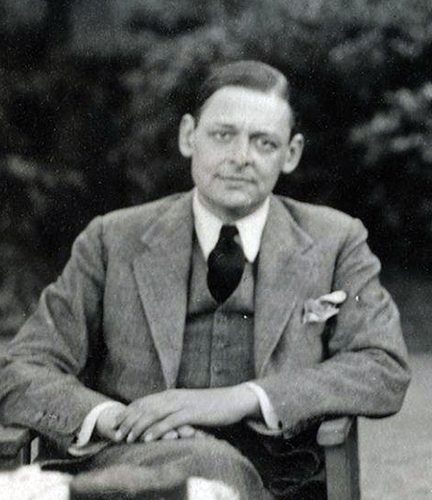
At a Glance
- Born
- September 26, 1888, St. Louis, Missouri
- Died
- January 4, 1965, Kensington, London (age 76)
- Era
- Modernist
- Known for
- The Waste Land, “The Love Song of J. Alfred Prufrock,” Four Quartets, Old Possum’s Book of Practical Cats
- Education
- Harvard University (BA 1909, MA 1910); University of Paris; Merton College, Oxford
- Occupation
- Poet, critic, playwright, editor, and publisher
- Spouses
- Vivienne Haigh-Wood (married 1915); Valerie Fletcher (married 1957)
- Honors
- Nobel Prize in Literature (1948); Order of Merit (1948); Presidential Medal of Freedom (1964)
- Buried
- St. Michael and All Angels’ Church, East Coker, Somerset (ashes)
ON THIS PAGE
Why He Matters · Timeline · Life and Career · Poetry and Style · Famous Poems and Books · Legacy · FAQ
Related Poets
Why T. S. Eliot Matters
Eliot changed what a poem in English could sound like. Before him, most readers expected a single speaker, a steady meter, and a clear line of thought. Prufrock mutters, stalls, and interrupts himself, and The Waste Land shifts among dozens of voices, several languages, and scraps of songs, sermons, and overheard gossip. Nearly every later poet who uses collage, fragments, or allusion is working in a space Eliot opened.
He mattered just as much as a critic and a gatekeeper. His essays, especially “Tradition and the Individual Talent” (1919), taught a generation to read poems closely and to value Donne and the Metaphysical poets over the Victorians. As a director at Faber and Faber for 40 years, he published W. H. Auden, Ted Hughes, and many others. Few writers have shaped both the poetry of their time and the way it was read.
T. S. Eliot Timeline
These are the key dates in Eliot’s life and work.
- 1888
- Thomas Stearns Eliot is born in St. Louis, Missouri, on September 26, the youngest of seven children.
- 1906
- He enters Harvard, where he reads the French Symbolist poets.
- 1910
- He finishes his master’s degree and spends a year in Paris at the Sorbonne.
- 1914
- He studies at Merton College, Oxford, and meets Ezra Pound in London.
- 1915
- “The Love Song of J. Alfred Prufrock” appears in Poetry magazine, and he marries Vivienne Haigh-Wood on June 26.
- 1917
- He starts work at Lloyds Bank and publishes his first book, Prufrock and Other Observations.
- 1919
- His essay “Tradition and the Individual Talent” is published.
- 1920
- The Sacred Wood, his first book of criticism, is published.
- 1922
- The Waste Land appears in the first issue of The Criterion, the quarterly he edits until 1939.
- 1925
- He leaves the bank for the publisher Faber and Gwyer and publishes “The Hollow Men.”
- 1927
- He is baptized into the Church of England on June 29, publishes “Journey of the Magi,” and becomes a British subject in November.
- 1930
- Ash-Wednesday, his first long religious poem, is published.
- 1933
- He separates from Vivienne after lecturing at Harvard for a year.
- 1935
- His verse play Murder in the Cathedral opens at the Canterbury Festival.
- 1939
- Old Possum’s Book of Practical Cats is published, and The Criterion closes.
- 1943
- Four Quartets is published as a single book.
- 1947
- Vivienne dies in a London mental hospital.
- 1948
- He receives the Nobel Prize in Literature and the Order of Merit.
- 1949
- The Cocktail Party opens and becomes his biggest stage success.
- 1957
- He marries his secretary, Valerie Fletcher, on January 10.
- 1964
- He is awarded the US Presidential Medal of Freedom.
- 1965
- He dies in London on January 4, and his ashes are placed in the church at East Coker.
- 1981
- Cats, Andrew Lloyd Webber’s musical based on his cat poems, opens in London.
- 1983
- He wins two posthumous Tony Awards for Cats.
Life and Career
Eliot’s life divides into two halves: an American youth spent preparing for an academic career and an English adulthood spent as a banker, editor, publisher, and churchman.
St. Louis and Harvard (1888–1914)
Eliot grew up in a prosperous St. Louis family with deep New England roots. His grandfather founded Washington University, his father ran a brick company, and his mother wrote poetry. He studied at Smith Academy and Milton Academy, then at Harvard, where he read philosophy and discovered Jules Laforgue and the French Symbolists. A year in Paris in 1910 and 1911 gave him the urban scenes of his early poems, and he returned to Harvard to begin a doctorate on the philosopher F. H. Bradley.
London, Pound, and Prufrock (1914–1921)
A traveling fellowship brought Eliot to Oxford in 1914, and he never really went home. Ezra Pound read “Prufrock” and got it published in Chicago’s Poetry magazine in 1915. That same year, Eliot hastily married Vivienne Haigh-Wood, a lively and often unwell Englishwoman, and gave up his planned academic career. He taught school, then joined Lloyds Bank in 1917, writing poems and reviews at night. The strain of work, money, and a difficult marriage led to a breakdown in 1921.
The Waste Land and The Criterion (1921–1927)
During a rest cure at Margate and Lausanne, Eliot drafted most of The Waste Land. Pound cut the manuscript almost in half, and the poem appeared in October 1922 in The Criterion, the new review Eliot edited. It made him the most talked-about poet of his generation. In 1925, he left the bank for Faber and Gwyer, later Faber and Faber, where he worked for the rest of his life.
Conversion and the Later Poems (1927–1945)
In 1927, Eliot was baptized into the Church of England and became a British subject, and he later described himself as a classicist in literature, a royalist in politics, and an Anglo-Catholic in religion. His poetry turned toward faith with the Ariel poems, “Journey of the Magi” among them, and Ash-Wednesday (1930). He left Vivienne in 1933, and she was committed to a mental hospital in 1938. His major late work, Four Quartets, was written between 1935 and 1942, partly during the London Blitz.
Fame, the Theater, and a Second Marriage (1945–1965)
After the war, Eliot wrote mainly verse plays for the commercial stage, and The Cocktail Party (1949) was a hit in London and New York. The Nobel Prize and the Order of Merit in 1948 made him a public figure. In 1957, at 68, he married Valerie Fletcher, his 30-year-old secretary, and by his own account the marriage brought him happiness he had not known before. He died of emphysema in London in 1965.
Poetry and Style
Eliot’s early poems are built from fragments. He cuts between scenes without explanation, mixes high and low speech, and quotes Dante, Shakespeare, and music-hall songs side by side. His verse is mostly free or loosely metrical, but it is full of rhyme and rhythm that surface and vanish, so a passage can sound like conversation one moment and incantation the next. He called the method finding an “objective correlative”: a set of objects or events that call up an emotion without naming it.
His subjects are the modern city, spiritual emptiness, time, and the hope of redemption. The later poems grow calmer and more meditative, with long, patient lines that circle an idea rather than splinter it. The weakness of the method is difficulty: the allusions can shut out readers who lack his library, and the notes he added to The Waste Land sometimes confuse more than they help. Some early poems also contain antisemitic portraits that many readers find impossible to set aside.
Famous Poems and Books
These are the works most readers meet first.
- The Love Song of J. Alfred Prufrock (1915): A timid man’s monologue on the way to a party, and the poem that announced modernism in English.
- Prufrock and Other Observations (1917): His first book, with “Preludes,” “Portrait of a Lady,” and “Rhapsody on a Windy Night.”
- The Waste Land (1922): A five-part collage of voices and myths about a broken postwar world.
- The Hollow Men (1925): A bleak poem of spiritual paralysis that ends “Not with a bang but a whimper.”
- Journey of the Magi (1927): An old wise man remembers the birth that felt like a death.
- Ash-Wednesday (1930): A long poem of penitence and prayer written after his conversion.
- Murder in the Cathedral (1935): A verse play about the killing of Thomas Becket.
- Old Possum’s Book of Practical Cats (1939): Light verse for children that became the musical Cats.
- Four Quartets (1943): Four meditations on time and eternity, often called his masterpiece.
Reputation and Legacy
From the 1920s to the 1950s, Eliot was the dominant figure in English-language poetry, and his critical ideas shaped the New Criticism that ruled university English departments for decades. A reaction set in after his death, as poets turned toward plainer, more personal verse and critics questioned his politics. The debate over his antisemitism, sharpened by Anthony Julius’s 1995 study, continues, and the opening in 2020 of his letters to Emily Hale at Princeton revealed a long private romance that has changed how biographers read his life.
His popular afterlife is just as strong. Lines such as “April is the cruellest month” and “This is the way the world ends” are part of everyday English. Cats, based on his children’s poems, opened in London in 1981, ran for 21 years, and earned him two posthumous Tony Awards. He is commemorated in Poets’ Corner in Westminster Abbey and at East Coker, the Somerset village his ancestors left for America.
Frequently Asked Questions
These are the questions people most often ask about T. S. Eliot.
Who was T. S. Eliot?
T. S. Eliot was an American-born British poet, critic, and playwright, and one of the leading figures of modernist literature. He wrote The Waste Land and Four Quartets and won the Nobel Prize in Literature in 1948.
What is T. S. Eliot’s most famous poem?
The Waste Land (1922) is his most famous poem and one of the most influential poems of the 20th century. “The Love Song of J. Alfred Prufrock” (1915) is a close second and is usually the first Eliot poem students read.
What does the T. S. in T. S. Eliot stand for?
It stands for Thomas Stearns, his full name. Stearns was his mother’s maiden name, and he was born Thomas Stearns Eliot in St. Louis, Missouri, on September 26, 1888.
Did T. S. Eliot write Cats?
Not directly. The musical Cats (1981) was composed by Andrew Lloyd Webber, who set poems from Eliot’s Old Possum’s Book of Practical Cats (1939) to music, and Eliot won two posthumous Tony Awards for it in 1983.
Was T. S. Eliot religious?
Yes. Raised a Unitarian, he was baptized into the Church of England in 1927 and remained a devout Anglo-Catholic for the rest of his life. His later poems, including Ash-Wednesday and Four Quartets, are deeply religious.
Related Poets
These poets shaped Eliot or shared his world.
- Ezra Pound: His friend and champion, who placed “Prufrock” in print and edited The Waste Land.
- W. B. Yeats: The other giant of early modernist poetry in English, and a fellow Nobel laureate.
- John Donne: The Metaphysical poet Eliot’s essays helped restore to the center of English poetry.
- Robert Frost: An American contemporary who took the opposite road, staying with traditional forms and plain speech.