Robert Frost (1874–1963) was an American poet best known for “The Road Not Taken” and “Stopping by Woods on a Snowy Evening,” short lyrics of rural New England first published in 1915 and 1923. He is the only poet to win the Pulitzer Prize for Poetry four times, and in 1961, at the age of 86, he recited “The Gift Outright” at John F. Kennedy’s inauguration.
Our view: Frost’s folksy image hides a much darker poet. Behind the farmer’s voice and the tidy rhymes are poems about isolation, fear, grief, and the stories people tell themselves to get through the day. He kept meter and rhyme while his modernist peers gave them up, and he used that old music to say unsettling, modern things. Read closely, the poet of graduation cards is one of America’s most unsparing.
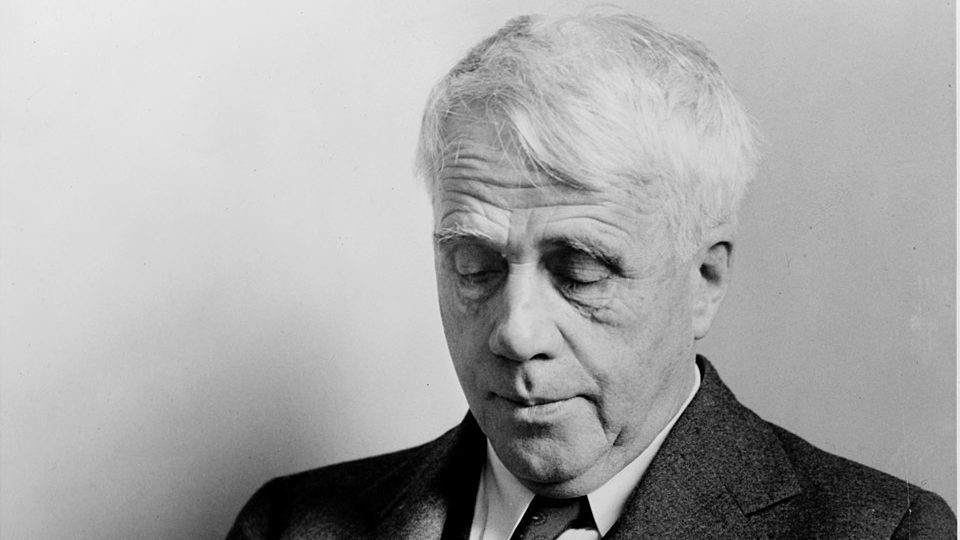
At a Glance
- Born
- March 26, 1874, San Francisco, California
- Died
- January 29, 1963 (aged 88), Boston, Massachusetts
- Era
- Modernist
- Known for
- “The Road Not Taken,” “Stopping by Woods on a Snowy Evening,” and “Mending Wall”
- Education
- Dartmouth College (1892) and Harvard University (1897–1899), no degree
- Occupation
- Poet, teacher, and farmer
- Spouse
- Elinor Miriam White (married 1895; she died in 1938)
- Honors
- Four Pulitzer Prizes for Poetry, the Congressional Gold Medal (1960), and the Bollingen Prize (1963)
- Buried
- Old Bennington Cemetery, Bennington, Vermont
ON THIS PAGE
Why He Matters · Timeline · Life and Career · Poetry and Style · Famous Poems and Books · Legacy · FAQ
Related Poets
Why Robert Frost Matters
Frost is the rare poet whose lines live outside books. People who have never read a poetry collection can finish “miles to go before I sleep” or “the one less traveled by.” He earned that reach without dumbing anything down. His poems are built from plain words and everyday scenes, such as a wall, a snowy road, or a pile of apples, so they reward a first reading and keep paying out on the tenth.
The deeper reason to read him is what lies under the plain surface. “Home Burial” is a marriage breaking apart over a dead child, “Design” finds a cold intelligence behind nature, and “Acquainted with the Night” is a portrait of loneliness as stark as anything in modern poetry. Frost showed that traditional form could carry modern doubt, and that a poem can sound simple and still refuse to comfort you.
Robert Frost Timeline
- 1874
- Born on March 26 in San Francisco, California, to the journalist William Prescott Frost Jr. and Isabelle Moodie.
- 1885
- After his father’s death, moves with his mother and sister to Lawrence, Massachusetts.
- 1892
- Graduates from Lawrence High School as co-valedictorian with Elinor White, then spends a few months at Dartmouth College.
- 1894
- Sells his first poem, “My Butterfly. An Elegy,” to The Independent for $15.
- 1895
- Marries Elinor Miriam White on December 19.
- 1897
- Enters Harvard University, which he leaves in 1899 without a degree.
- 1900
- Loses his first son, Elliott, and moves the family to a farm in Derry, New Hampshire.
- 1906
- Begins teaching English at Pinkerton Academy in Derry, where he stays until 1911.
- 1912
- Sells the farm and moves his family to England.
- 1913
- Publishes his first book, A Boy’s Will, in London.
- 1914
- Publishes North of Boston and befriends the English writer Edward Thomas.
- 1915
- Returns to the United States, buys a farm in Franconia, New Hampshire, and publishes “The Road Not Taken.”
- 1916
- Publishes Mountain Interval.
- 1917
- Begins teaching at Amherst College, his academic home on and off until 1938.
- 1921
- Begins his long association with the Bread Loaf School of English in Vermont.
- 1924
- Wins his first Pulitzer Prize, for New Hampshire (1923).
- 1931
- Wins his second Pulitzer Prize, for Collected Poems.
- 1937
- Wins his third Pulitzer Prize, for A Further Range.
- 1938
- His wife, Elinor, dies.
- 1943
- Wins his fourth Pulitzer Prize, for A Witness Tree.
- 1958
- Serves as Consultant in Poetry to the Library of Congress, the post now called Poet Laureate.
- 1960
- Congress votes to award him the Congressional Gold Medal.
- 1961
- Recites “The Gift Outright” at John F. Kennedy’s inauguration and is named poet laureate of Vermont.
- 1962
- Travels to the Soviet Union with Secretary of the Interior Stewart Udall.
- 1963
- Dies on January 29 in Boston and is buried in Bennington, Vermont.
Life and Career
Frost’s life splits into two very different halves. For nearly four decades, he struggled as a farmer and teacher, with few poems in print. Then, within about three years, he became one of the most famous poets in the English-speaking world.
San Francisco to Lawrence (1874–1892)
Frost was born in San Francisco, the son of a hard-drinking journalist and a Scottish-born schoolteacher. When his father died of tuberculosis in 1885, his mother took Robert and his sister east to Lawrence, Massachusetts, where his grandfather helped support them. The boy who would become the voice of New England was, in fact, a transplant. At Lawrence High School, he excelled, and in 1892 he shared the valedictory honors with Elinor White, the woman he would marry.
False Starts and the Derry Farm (1892–1912)
Frost lasted only a few months at Dartmouth. In 1894, he sold his first poem, “My Butterfly. An Elegy,” to The Independent, and in 1895 he married Elinor. He studied at Harvard from 1897 to 1899 but left without a degree. In 1900, the year their first son, Elliott, died, the family moved to a farm in Derry, New Hampshire, bought for them by Frost’s grandfather.
Frost was a poor farmer, but the Derry years gave him nearly all his material: stone walls, orchards, woodlots, and the talk of his neighbors. From 1906 to 1911, he taught English at Pinkerton Academy. By his late thirties, he had published only a handful of poems in magazines.
England and the Breakthrough (1912–1915)
In 1912, Frost sold the farm and took his family to England, a gamble that paid off quickly. A London publisher brought out A Boy’s Will in 1913, and North of Boston followed in 1914. Its blank-verse dialogues, including “Mending Wall,” “Home Burial,” and “The Death of the Hired Man,” won strong reviews. In Gloucestershire, he formed a close friendship with Edward Thomas, whom he encouraged to write poetry and whose habits on their country walks inspired “The Road Not Taken.”
Fame in America (1915–1938)
Frost came home in 1915 to find his books in demand. He bought a farm in Franconia, New Hampshire, published Mountain Interval in 1916, and began teaching at Amherst College in 1917. From 1921, he spent summers at the Bread Loaf School of English in Vermont. New Hampshire (1923), which contains “Stopping by Woods on a Snowy Evening,” won him his first Pulitzer Prize, and he won again for Collected Poems (1931) and A Further Range (1937). He became a celebrated public reader, performing the role of the wry New England sage.
Grief and National Honors (1938–1963)
Frost’s public success sat beside private tragedy. Of his six children, only two outlived him. His daughter Marjorie died after childbirth in 1934, Elinor died in 1938, and his son Carol died in 1940. Frost kept writing, and A Witness Tree (1942) brought his fourth Pulitzer Prize.
In old age, he became a national figure. He served as Consultant in Poetry to the Library of Congress in 1958, and Congress voted him a Congressional Gold Medal in 1960. At Kennedy’s inauguration in January 1961, the sun’s glare kept him from reading a new poem, so he recited “The Gift Outright” from memory. In 1962, he visited the Soviet Union on a cultural mission. He died in Boston on January 29, 1963, after complications following surgery, and was buried in Bennington, Vermont.
Poetry and Style
Frost built his poems on what he called “the sound of sense,” the rise and fall of the human voice in real speech. He set that voice against strict meter, most often blank verse or rhymed iambic lines, so that sentences seem to talk across the beat. He had little patience for free verse and compared writing it to playing tennis with the net down. The result is verse that sounds casual but is tightly made.
His subjects are rural and small: mending a wall, picking apples, a boy cutting wood, a horse in the snow. Under them run large questions about choice, isolation, work, marriage, and death. He wrote two main kinds of poem: short lyrics, such as “Fire and Ice” and “Nothing Gold Can Stay,” and longer blank-verse dramas, such as “Home Burial,” in which characters talk past each other. The dramas are among his finest work and are less read than the lyrics.
Frost has weaknesses. In his later books, the wit can harden into sermon, and the persona of the wise old farmer sometimes crowds out the poem. Some of his verse from the 1930s and 1940s reads as argument rather than art. His best work, however, holds its ironies so lightly that many readers take it at face value, which is both his charm and the reason he is so often misread.
Famous Poems and Books
Frost published more than a dozen collections. These are the books and poems that made and sustain his reputation.
- A Boy’s Will (1913): His first book, published in London, a sequence of lyrics about youth, love, and solitude.
- North of Boston (1914): The book that made his name, with blank-verse dialogues of New England farm life.
- Mending Wall (1914): Two neighbors rebuild a stone wall, and the speaker questions the proverb that good fences make good neighbors.
- Home Burial (1914): A husband and wife argue on a staircase over the grave of their child, one of the most painful poems about marriage in English.
- The Road Not Taken (1915): A traveler chooses between two roads and predicts the story he will tell about it, his most quoted and most misread poem.
- Birches (1915): A grown man remembers swinging on birch trees and wishes he could climb away from the world and come back again.
- Mountain Interval (1916): His first book after returning to America, which opens with “The Road Not Taken.”
- Fire and Ice (1920): Nine lines weighing whether the world will end in desire or in hate.
- Stopping by Woods on a Snowy Evening (1923): A rider pauses by dark woods on the darkest evening of the year, torn between rest and duty.
- Nothing Gold Can Stay (1923): Eight lines on how every first beauty fades, from spring leaves to Eden.
- Acquainted with the Night (1928): A solitary walker in a city at night, one of the loneliest poems of the century.
- The Gift Outright (1942): A short history of America as a nation that had to give itself to the land, recited at Kennedy’s inauguration.
Reputation and Legacy
For much of his life, Frost was admired by the public and doubted by critics, who saw him as a skilled but old-fashioned rural poet. That view changed after Randall Jarrell’s 1947 essay “The Other Frost,” which argued for the dark, subtle poet beneath the popular one. At Frost’s 85th birthday dinner in 1959, the critic Lionel Trilling went further and called him a terrifying poet, a remark that stirred controversy at the time and is now widely accepted.
After his death, Lawrance Thompson’s authorized three-volume biography painted Frost as vain, jealous, and cruel to his family. Later biographers, including Jay Parini, gave a more balanced portrait of a difficult man shaped by great loss. His poems, meanwhile, never left the classroom. His farm in Derry and his homes in Franconia and Shaftsbury, Vermont, are now open to visitors, and lines like “miles to go before I sleep” remain part of everyday American speech.
Frequently Asked Questions
These are the questions readers most often ask about Robert Frost’s life and death.
Who Was Robert Frost?
Robert Frost (1874–1963) was an American poet known for poems of rural New England such as “The Road Not Taken” and “Stopping by Woods on a Snowy Evening.” He won four Pulitzer Prizes for Poetry and read at John F. Kennedy’s inauguration in 1961.
When and Where Was Robert Frost Born?
He was born on March 26, 1874, in San Francisco, California. After his father died in 1885, his mother moved the family to Lawrence, Massachusetts, and New England became his home and his subject.
How Did Robert Frost Die?
He died in his sleep on January 29, 1963, at Peter Bent Brigham Hospital in Boston, at the age of 88. He had undergone an operation there in December 1962, and he then suffered a heart attack and blood clots in his lungs.
Where Is Robert Frost Buried?
He is buried in the Old Bennington Cemetery in Bennington, Vermont. His gravestone carries a line from his poem “The Lesson for Today”: “I had a lover’s quarrel with the world.”
What Inspired Robert Frost to Write Poetry?
Rural New England life, especially his years farming in Derry, New Hampshire, gave him most of his subjects. He was also drawn to the rhythms of ordinary speech, which he called “the sound of sense,” and his friendship with Edward Thomas in England helped inspire poems such as “The Road Not Taken.”
Related Poets
- Emily Dickinson: A fellow New Englander whose short, compressed lyrics probe nature and death with the same hidden darkness.
- Walt Whitman: The father of American free verse, and the expansive opposite of Frost’s restraint.
- Ralph Waldo Emerson: The New England thinker Frost read from boyhood, whose ideas about nature and self-reliance run through his poems.
- William Wordsworth: An earlier poet of country people in plain speech, whose rural blank verse is a direct ancestor of North of Boston.
- Edward Thomas: The English writer and close friend whom Frost urged to write poetry, and whose country walks inspired “The Road Not Taken.”