Wilfred Owen (1893–1918) was an English poet best known for “Dulce et Decorum Est” and “Anthem for Doomed Youth,” poems written in 1917 that show the First World War as the soldiers in the trenches experienced it. He wrote nearly all his important work in little more than a year, after meeting Siegfried Sassoon at an Edinburgh hospital for shell-shocked officers. He was killed on November 4, 1918, a week before the Armistice, with only five poems in print.
Our view: Owen is the poet who changed what war poetry was allowed to say. He kept the music he learned from Keats and turned it on gas, mud, and shattered bodies, so the beauty of his lines makes the horror impossible to skim. He called his subject “the pity of War,” and that pity is still how the English-speaking world remembers 1914 to 1918.
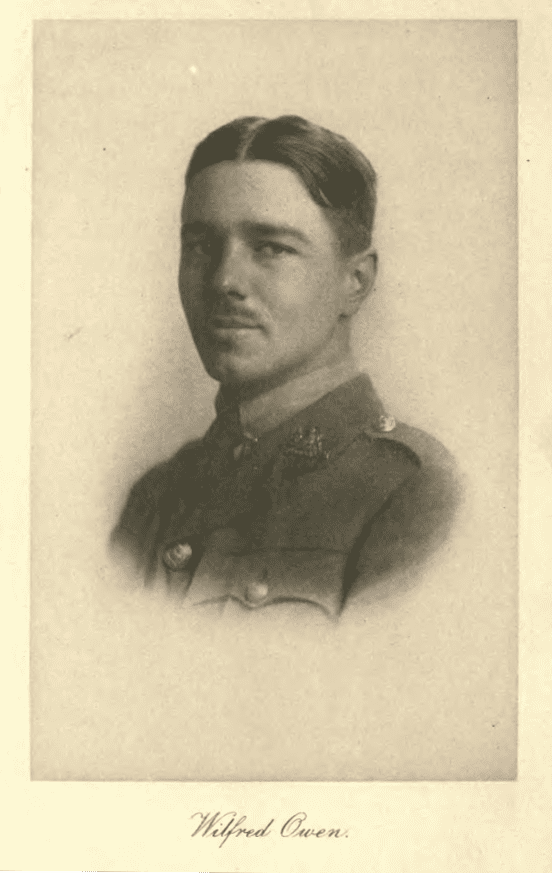
At a Glance
- Born
- March 18, 1893, Plas Wilmot, near Oswestry, Shropshire, England
- Died
- November 4, 1918 (aged 25), Sambre–Oise Canal, near Ors, France
- Era
- Modernist, First World War
- Known for
- “Dulce et Decorum Est,” “Anthem for Doomed Youth,” “Strange Meeting,” and “Futility”
- Education
- Birkenhead Institute and Shrewsbury Technical School; classes at University College, Reading
- Occupation
- Poet, teacher, and army officer
- Honors
- Military Cross (awarded for action on October 1, 1918)
- Buried
- Ors Communal Cemetery, Ors, France
ON THIS PAGE
Why He Matters · Timeline · Life and Career · Poetry and Style · Famous Poems and Books · Legacy · FAQ
Related Poets
Why Wilfred Owen Matters
Before Owen, the best-known English poems of the First World War spoke of honor and sacrifice. Rupert Brooke’s “The Soldier” imagined a corner of a foreign field that would be “for ever England.” Owen’s poems offered a man drowning in gas instead, and with the “old Lie” that it is sweet and fitting to die for your country. He did not write against soldiers. He wrote for them, against the people and the language that sent them to die.
He matters as an artist, too. Owen was a craftsman who experimented with sound, above all with pararhyme, the half-rhymes such as “escaped” and “scooped” that give his late poems their haunted, unresolved echo. His output is small, and much of it survives in drafts, yet it has shaped every serious war poem written in English since, and his words are cut into the memorial to the war poets in Westminster Abbey.
Wilfred Owen Timeline
These are the key dates in Owen’s short life, from a Shropshire childhood to the Sambre–Oise Canal.
- 1893
- Born Wilfred Edward Salter Owen on March 18 at Plas Wilmot, his grandfather’s house near Oswestry, Shropshire, the eldest of four children.
- 1897
- His grandfather dies and the house is sold; the family moves to Birkenhead, then briefly to Shrewsbury.
- 1898
- His father, a railway worker, becomes stationmaster at Woodside in Birkenhead, where Owen attends the Birkenhead Institute.
- 1907
- The family returns to Shrewsbury, and he enrolls at Shrewsbury Technical School.
- 1911
- Passes the University of London matriculation exam, but not with the honors needed for a scholarship.
- 1911
- Becomes lay assistant to the vicar of Dunsden, near Reading, and takes classes at University College, Reading.
- 1913
- Leaves Dunsden in February, disillusioned with the church, and moves to Bordeaux to teach English at the Berlitz School of Languages.
- 1914
- Works as a private tutor in France and meets the French poet Laurent Tailhade.
- 1915
- Returns to England and enlists in the Artists Rifles on October 21.
- 1916
- Commissioned as a second lieutenant in the Manchester Regiment on June 4.
- 1917
- Arrives in France on January 1 and goes into the line on the Somme in bitter winter weather.
- 1917
- In the spring, he suffers concussion in a fall and is blown into the air by a shell, then lies for days near a fellow officer’s remains; he is diagnosed with shell shock.
- 1917
- Arrives at Craiglockhart War Hospital in Edinburgh on June 25 and edits its magazine, The Hydra.
- 1917
- Meets Siegfried Sassoon in mid-August and, by October, writes “Anthem for Doomed Youth” and “Dulce et Decorum Est.”
- 1917
- Discharged in November and posted to light duties with the 5th Manchesters in Scarborough.
- 1918
- “Miners” appears in The Nation in January, one of only five poems published in his lifetime.
- 1918
- Posted to Ripon in March, where he writes or revises “Futility” and “Strange Meeting.”
- 1918
- Passed fit for active service in June and returns to France in August.
- 1918
- Leads his men in the attack on the Beaurevoir–Fonsomme Line on October 1, winning the Military Cross.
- 1918
- Killed on November 4 while his battalion tries to cross the Sambre–Oise Canal near Ors; his mother receives the telegram on Armistice Day, November 11.
- 1920
- Poems, edited by Siegfried Sassoon with help from Edith Sitwell, is published in December.
- 1931
- Edmund Blunden’s fuller edition, The Poems of Wilfred Owen, wins him a wider readership.
- 1962
- Benjamin Britten’s War Requiem, setting nine of his poems, premieres at the rebuilt Coventry Cathedral.
- 1985
- Commemorated with 15 other war poets on a memorial stone in Poets’ Corner, Westminster Abbey, on November 11.
Life and Career
Owen’s life divides into a long apprenticeship and a very short, intense maturity. Almost everything that made him famous was written between August 1917 and September 1918.
A Railway Family (1893–1911)
Owen was born into a family that had come down in the world. His mother, Susan, grew up in comfort at Plas Wilmot, but after her father’s death in 1897 the house was sold, and the Owens lived on the modest wages of Tom Owen, a railway clerk who rose to stationmaster. The family moved between Birkenhead and Shrewsbury, and Wilfred, the eldest child, was close to his devout, ambitious mother all his life. Most of what we know of him comes from the hundreds of letters he wrote to her.
He was a bookish boy who decided early that he would be a poet, and his first idol was John Keats. At school in Birkenhead and Shrewsbury he did well, and he worked as a pupil-teacher, but the family could not afford university without a scholarship, and in 1911 he missed the grade he needed.
Dunsden and a Crisis of Faith (1911–1913)
Instead, Owen became lay assistant to the evangelical vicar of Dunsden, a village near Reading, in return for board and tutoring, and he attended classes in botany and Old English at University College, Reading. The arrangement was meant to lead to ordination. It led instead to doubt. Owen was troubled by the poverty he saw among the parishioners and by what he felt was the church’s indifference to it, and in February 1913 he left, ill and unsure of his faith. The experience left its mark on his war poems, which constantly measure Christian language against what he saw.
France and Enlistment (1913–1916)
Later in 1913, Owen went to Bordeaux to teach English at the Berlitz School of Languages, and he stayed in France as a private tutor after war broke out in 1914. There, he met the poet Laurent Tailhade, an early literary mentor. He returned to England in 1915, enlisted in the Artists Rifles on October 21, and after months of training was commissioned into the Manchester Regiment in June 1916.
The Western Front (1917)
Owen reached France on January 1, 1917, and was soon in the front line on the Somme during one of the coldest winters on record. In the spring, he fell into a shell hole and suffered concussion, and later he was blown into the air by a shell and spent days sheltering near the remains of a fellow officer. In May, he was evacuated, diagnosed with shell shock (then called neurasthenia), and sent home.
Craiglockhart and Sassoon (1917)
On June 25, 1917, Owen arrived at Craiglockhart War Hospital in Edinburgh. His doctor, Arthur Brock, believed in treating patients through activity, and encouraged him to write and to edit the hospital magazine, The Hydra. In mid-August, Owen introduced himself to a fellow patient, Siegfried Sassoon, who had been sent to Craiglockhart after publicly protesting the war. Sassoon read Owen’s poems, urged him to write plainly from his own experience, and helped revise his drafts. Through Sassoon, Owen met Robert Graves and the literary figure Robert Ross.
The change was immediate. Within weeks, Owen had written “Anthem for Doomed Youth” and “Dulce et Decorum Est,” and in the following months came “Disabled,” “Insensibility,” and others. He left Craiglockhart in November 1917.
The Last Year (1917–1918)
Owen spent the winter on light duties with the 5th Manchesters in Scarborough, working on his poems in a hotel room overlooking the sea, and in March 1918 he was posted to Ripon, where he wrote or revised “Futility” and “Strange Meeting.” He drafted a preface for a book he never saw published, beginning “This book is not about heroes.” In June, he was passed fit, and although he could have sought a safer post, he chose to return to the front. He wrote to his mother that he was going back to help his men, both by leading them and by witnessing their suffering so that he could speak for them.
He crossed to France in August 1918. On October 1, he led his men in an attack on the Beaurevoir–Fonsomme Line, using a captured German machine gun to inflict heavy losses, and was awarded the Military Cross. On November 4, 1918, the 2nd Manchesters attempted to cross the Sambre–Oise Canal near Ors under heavy fire, and Owen was killed. He was 25. He was promoted to lieutenant the day after his death. The telegram reached his parents in Shrewsbury on November 11, as the church bells rang for the Armistice.
Poetry and Style
Owen’s early poems are lush imitations of Keats, full of sensuous description and melancholy. What changed in 1917 was not his ear but his subject. He kept the rich music of the Romantics and applied it to things the Romantics never had to describe: gas, trench foot, shell shock, and bodies caught on wire. The effect is doubly disturbing, because the lines are beautiful and what they show is not. Sassoon taught him to be direct and to use irony, but Owen’s poems are less satirical than Sassoon’s and more compassionate. As he put it in his draft preface, “My subject is War, and the pity of War. The Poetry is in the pity.”
His great technical contribution was pararhyme, in which two words share their consonants but not their vowel, as in “escaped” and “scooped,” or “groined” and “groaned,” in “Strange Meeting.” Owen was not the first to use it, but no one had used it so consistently or to such effect. The rhymes almost chime and then fail, like an echo gone wrong, and they suit a world where nothing resolves. He also used heavy assonance and alliteration to mimic the sounds of battle, as in the “stuttering rifles’ rapid rattle” of “Anthem for Doomed Youth.”
His weaknesses are real. Some poems slip into overwriting or sentimentality, and because he died so young, many survive only as drafts that he never finished revising. W. B. Yeats famously left him out of The Oxford Book of Modern Verse (1936), arguing that passive suffering was not a fit subject for poetry, and privately dismissed his work as “all blood, dirt, and sucked sugar stick.” Few readers now agree.
Famous Poems and Books
Owen’s reputation rests on a small group of poems written in 1917 and 1918, most of them published after his death.
- Dulce et Decorum Est (1917): A gas attack seen through the eyes of a soldier who cannot save his comrade, ending with the Latin tag it calls “the old Lie.”
- Anthem for Doomed Youth (1917): A sonnet asking what funeral rites exist for soldiers who “die as cattle,” revised with Sassoon at Craiglockhart.
- Disabled (1917): A young man who enlisted for glory sits in a wheelchair, legless, watching the life he has lost.
- Strange Meeting (1918): A dream of meeting, in hell, the enemy soldier the speaker killed; the best-known example of Owen’s pararhyme.
- Futility (1918): A short elegy in which soldiers move a dead comrade into the sun, and the speaker asks why the earth was ever made.
- Spring Offensive (1918): One of his last poems, describing men resting in a sunlit field before a charge.
- Poems (1920): The first collection: 23 poems, edited and introduced by Siegfried Sassoon.
- The Complete Poems and Fragments (1983): Jon Stallworthy’s scholarly edition, which includes every surviving draft.
Reputation and Legacy
Owen was almost unknown when he died. Seven of his poems appeared in Edith Sitwell’s anthology Wheels in 1919, and Sassoon’s edition followed in 1920, but it was Edmund Blunden’s fuller edition of 1931 that built a lasting readership. A second revival came in the 1960s, when C. Day Lewis’s edition of the collected poems appeared in 1963, the year after Benjamin Britten’s War Requiem set Owen’s poems beside the Latin Mass. Owen became the defining voice of the war for later generations and a fixture of school syllabuses across the English-speaking world.
His life has also become a story in its own right. Pat Barker’s Regeneration trilogy (1991–1995) dramatizes his friendship with Sassoon, as did the 1997 film Regeneration and Terence Davies’s film Benediction (2021). His grave at Ors carries lines adapted by his mother from his poem “The End,” and the forester’s house near the canal where he spent his last night is now a memorial. On November 11, 1985, he was commemorated with 15 other war poets in Poets’ Corner, Westminster Abbey, under words from his own preface: “My subject is War, and the pity of War. The Poetry is in the pity.”
Frequently Asked Questions
These are the questions readers most often ask about Wilfred Owen.
How Did Wilfred Owen Die?
He was killed in action on November 4, 1918, while leading his men across the Sambre–Oise Canal near Ors in northern France. He was 25, and the war ended one week later.
What Is Wilfred Owen Famous For?
He is famous for his poems of the First World War, which describe the reality of trench warfare with unflinching detail and deep compassion. He is widely regarded as the greatest English poet of that war.
What Is Wilfred Owen’s Most Famous Poem?
His most famous poem is “Dulce et Decorum Est,” written in 1917, which describes a gas attack and rejects the idea that it is sweet and fitting to die for your country. “Anthem for Doomed Youth” is a close second.
Was Wilfred Owen Anti-War?
He was against the glorification of war, not against the soldiers who fought it. He returned to the front in 1918, won the Military Cross, and wrote that he went back to help his men and to bear witness to their suffering.
How Many Poems Did Wilfred Owen Publish in His Lifetime?
Only five of his poems were published before his death, in the Craiglockhart magazine The Hydra and the London weekly The Nation. Almost all his work, including his most famous poems, appeared after he was killed.
Related Poets
These poets shaped Owen’s work, wrote about the same war, or share his themes of youth and early death.
- John Keats: Owen’s first and lasting model, whose rich sound he carried into the trenches.
- Rupert Brooke: The idealistic poet of 1914, whose patriotic sonnets represent the view of war Owen’s poems overturned.
- John McCrae: The Canadian doctor whose “In Flanders Fields” gave the war its most famous memorial poem.
- Thomas Hardy: An older poet whose bleak, ironic war poems, including “Channel Firing,” anticipated Owen’s tone.
- A. E. Housman: A fellow Shropshire poet, whose A Shropshire Lad mourns young men who die before their time.