A. E. Housman (1859–1936) was an English poet best known for A Shropshire Lad, the 1896 cycle of 63 short poems about youth, love, and early death in the English countryside. He was also one of the great classical scholars of his age, Kennedy Professor of Latin at Cambridge from 1911 until his death. His best-known poems include “To an Athlete Dying Young,” “Loveliest of Trees, the Cherry Now,” and “When I Was One-and-Twenty.”
Our view: Housman lived two lives and kept them apart. In public, he was a severe Latin professor famous for his sharp tongue. In private, he wrote some of the most tender, sorrowful lyrics in English, shaped by a love he could not declare. The simple, song-like surface of his poems is what makes their grief land so hard.
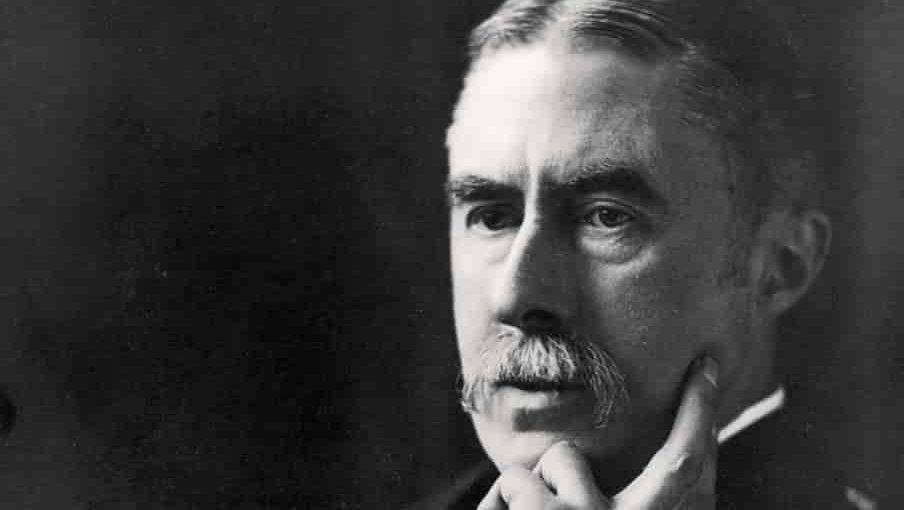
At a Glance
- Born
- March 26, 1859, Fockbury, near Bromsgrove, Worcestershire, England
- Died
- April 30, 1936 (aged 77), Cambridge, England
- Era
- Victorian
- Known for
- A Shropshire Lad, “To an Athlete Dying Young,” and “Loveliest of Trees, the Cherry Now”
- Education
- Bromsgrove School; St John’s College, Oxford
- Occupation
- Poet and classical scholar
- Honors
- Honorary Fellow of St John’s College, Oxford (1911); declined the Order of Merit (1929)
- Buried
- St Laurence’s Church, Ludlow, Shropshire (ashes)
ON THIS PAGE
Why He Matters · Timeline · Life and Career · Poetry and Style · Famous Poems and Books · Legacy · FAQ
Related Poets
Why A. E. Housman Matters
Housman proved how much a very short, very plain poem can hold. His lyrics use simple words, ballad meters, and neat rhymes, the tools of hymns and folk songs, yet they carry grief, longing, and a hard-won stoicism that readers still feel a century later. Few poets have done so much with so little: two slim books in his lifetime and a third after his death.
A Shropshire Lad also became one of the defining books of its time. Its doomed young countrymen and soldiers spoke directly to the generation that fought the First World War, and its poems drew English composers such as George Butterworth and Ralph Vaughan Williams to set them to music. For many readers, Housman is still where a love of poetry begins.
A. E. Housman Timeline
These are the key dates in Housman’s life and work.
- 1859
- Born Alfred Edward Housman on March 26 at Fockbury, near Bromsgrove, Worcestershire, the eldest of seven children of a solicitor.
- 1870
- Enters Bromsgrove School.
- 1871
- Loses his mother, Sarah Jane Housman, who dies on his 12th birthday.
- 1877
- Wins a scholarship to St John’s College, Oxford, where he meets Moses Jackson.
- 1879
- Takes a first in Classical Moderations.
- 1881
- Fails his final examinations in Greats and leaves Oxford without honors.
- 1882
- Becomes a clerk at the Patent Office in London, where Jackson also works, and keeps up his classical studies in his spare time.
- 1887
- Sees Moses Jackson leave England for a teaching post in India.
- 1892
- Is appointed Professor of Latin at University College London.
- 1896
- Publishes A Shropshire Lad at his own expense, through Kegan Paul, Trench, Trübner and Co.
- 1903
- Publishes the first volume of his edition of Manilius’s Astronomica.
- 1911
- Becomes Kennedy Professor of Latin at Cambridge and a fellow of Trinity College, and is made an honorary fellow of St John’s, Oxford.
- 1914
- Finds a vast new readership for A Shropshire Lad among soldiers and readers of the First World War.
- 1922
- Publishes Last Poems on October 19 and sends a copy to the dying Jackson in Canada.
- 1923
- Loses Moses Jackson, who dies in Canada.
- 1929
- Declines the Order of Merit.
- 1930
- Publishes the fifth and final volume of his Manilius.
- 1933
- Delivers the lecture The Name and Nature of Poetry at Cambridge.
- 1936
- Dies in Cambridge on April 30; his ashes are buried at Ludlow, and his brother Laurence publishes More Poems.
Life and Career
Housman’s life divides into a promising start, a painful failure, and a long, distinguished recovery, with his poetry written quietly alongside it.
Childhood in Worcestershire (1859–1877)
Housman was born at Fockbury, a hamlet outside Bromsgrove, the eldest of seven children of a country solicitor. Two of his siblings, Laurence and Clemence, also became writers. His mother died on his 12th birthday. A clever, reserved boy, he did well at Bromsgrove School and won a scholarship to Oxford. The Shropshire hills he could see on the western horizon later gave his most famous book its setting.
Oxford and Moses Jackson (1877–1881)
At St John’s College, Oxford, Housman took a first in Classical Moderations in 1879. He also formed the deepest attachment of his life, to a fellow student, Moses Jackson, an athletic science scholar who did not return his feelings. In 1881, to the shock of everyone who knew him, Housman failed his final examinations in Greats. He later returned to take a pass degree.
The Patent Office Years (1882–1892)
Housman took a clerk’s job at the Patent Office in London, where Jackson also worked, and for a time the two shared lodgings in Bayswater. They parted in 1885, and in 1887 Jackson left for India, where he later married. In the evenings, Housman worked at the British Museum on Latin and Greek texts, and his scholarly articles became so impressive that in 1892 he was appointed Professor of Latin at University College London.
A Shropshire Lad and University College London (1892–1911)
Housman wrote most of A Shropshire Lad in the mid-1890s, and after it was turned down by a publisher, he paid for its publication in 1896. It sold slowly at first but found a growing audience, helped by composers who set its poems to music. Meanwhile, he began his great edition of the Roman astronomical poet Manilius, whose first volume appeared in 1903.
Cambridge and Last Poems (1911–1936)
In 1911, Housman became Kennedy Professor of Latin at Cambridge and a fellow of Trinity College, where he lived for the rest of his life. He was known for exacting lectures and cutting reviews of other scholars. When he learned that Jackson was dying in Canada, he gathered Last Poems (1922), and it sold out its first printing at once. Jackson died the next year. Housman declined the Order of Merit in 1929, finished his Manilius in 1930, and gave his lecture The Name and Nature of Poetry in 1933. He died in Cambridge on April 30, 1936.
Poetry and Style
Housman’s poems are short, rhymed, and strictly metered, often in the quatrains of the ballad and the hymn. He admired the Scottish border ballads, Shakespeare’s songs, and Heine, and his classical training shows in the tight, epigram-like finish of his lines. His language is plain and his images are few: a cherry tree, a football field, a churchyard, a brook too broad for leaping.
His subjects are youth and its quick passing, love that is lost or never returned, soldiering, and death, which waits at the end of nearly every poem. The mood is stoic: the world is unjust and life is short, so endure it with courage. Critics have called the result monotonous and self-pitying, and it is true that his range is narrow. Within it, though, his control of sound and feeling is almost perfect.
Famous Poems and Books
These are the poems and books most readers meet first.
- A Shropshire Lad (1896): His cycle of 63 poems about young men in the Shropshire countryside, and his best-known book.
- Loveliest of Trees, the Cherry Now (1896): A young man of 20 counts how few springs he has left to see the cherry in bloom.
- When I Was One-and-Twenty (1896): Advice about love, ignored at 21 and proved true at 22.
- To an Athlete Dying Young (1896): An elegy for a young runner who dies before his fame can fade.
- With Rue My Heart Is Laden (1896): Eight lines of grief for friends who died young.
- On Wenlock Edge (1896): A gale in the woods links the speaker’s trouble to a Roman who felt the same on the same hill.
- Into My Heart an Air That Kills (1896): The “blue remembered hills” poem, on the lost country of youth.
- Last Poems (1922): His second and final collection published in his lifetime.
- The Name and Nature of Poetry (1933): His lecture arguing that poetry is felt physically before it is understood.
- More Poems (1936): Poems published after his death by his brother Laurence.
Reputation and Legacy
A Shropshire Lad has never gone out of print. It was especially loved during the First World War, when its poems of young men marching to their deaths seemed to describe the war itself. Composers took it up early: Ralph Vaughan Williams wrote On Wenlock Edge (1909), George Butterworth set poems from it in 1911 and 1912, and dozens of others followed. Among critics, his reputation has risen and fallen with taste, but poets as different as W. H. Auden, who wrote a sonnet about him, and Philip Larkin admired him.
Housman the scholar is remembered too. His Manilius is still a landmark of Latin textual criticism, and his savage reviews are quoted by classicists to this day. His private life has drawn wide interest since his death, most famously in Tom Stoppard’s play The Invention of Love (1997). In Ludlow, where his ashes lie, a cherry tree was planted near St Laurence’s Church in his memory.
Frequently Asked Questions
These are the questions people most often ask about A. E. Housman.
Who Was A. E. Housman?
A. E. Housman (1859–1936) was an English poet and classical scholar, best known for A Shropshire Lad (1896). By profession he was a Latin professor, first at University College London and then at Cambridge, and he published only two books of poems in his lifetime.
What Is A. E. Housman’s Most Famous Poem?
His most famous poem is “To an Athlete Dying Young,” an elegy for a young runner who dies at the height of his fame. “Loveliest of Trees, the Cherry Now” and “When I Was One-and-Twenty,” also from A Shropshire Lad, are nearly as well known.
What Is A Shropshire Lad About?
A Shropshire Lad is a cycle of 63 short poems about young men in an idealized English countryside, and about love, loss, and early death. Housman paid for its publication in 1896, and it slowly became one of the most popular books of English poetry, especially during the First World War.
Who Was Moses Jackson?
Moses Jackson was Housman’s closest friend at Oxford and the great, unreturned love of his life. They shared lodgings in London in the 1880s, and Jackson later moved to India and married. Housman assembled Last Poems in 1922 partly so that Jackson, then dying in Canada, could read it.
Where Is A. E. Housman Buried?
His ashes are buried outside St Laurence’s Church in Ludlow, Shropshire. He died in Cambridge on April 30, 1936, and a cherry tree was planted near the church in his memory.
Related Poets
These poets share Housman’s world or his mood.
- Thomas Hardy: A contemporary whose plain, fatalistic poems of rural England share Housman’s mood.
- Wilfred Owen: A war poet for whom Housman’s doomed young soldiers became real.
- Rupert Brooke: A young poet of the First World War, often read beside Housman for his English landscape and early death.
- Edward Thomas: A poet of the English countryside and quiet melancholy, killed in the First World War.
- W. B. Yeats: A contemporary who also built modern poems from ballad and song.