Laurence Binyon (1869–1943) was an English poet best known for “For the Fallen,” the 1914 elegy whose fourth stanza, “They shall grow not old, as we that are left grow old,” is recited as the Ode of Remembrance across the Commonwealth. He spent 40 years at the British Museum, where he became one of the first Western experts on Chinese and Japanese art, and in his last decade he translated Dante’s Divine Comedy.
Our view: Binyon is the rare poet remembered for a single stanza, and that stanza has outlived almost everything else written in 1914. But he was far more than a one-poem writer. A museum scholar who opened English eyes to Asian art, a volunteer orderly in wartime France, and a patient translator of Dante, he spent his life in the service of other people’s art, and in four lines he gave the dead a lasting promise.
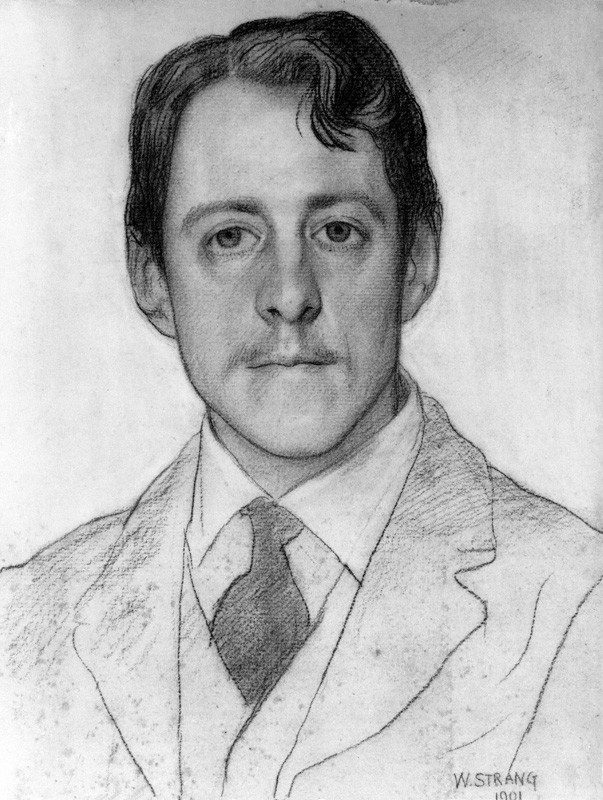
At a Glance
- Born
- August 10, 1869, Lancaster, England
- Died
- March 10, 1943 (aged 73), Reading, Berkshire, England
- Era
- Modernist, First World War
- Known for
- “For the Fallen” and its fourth stanza, the Ode of Remembrance
- Education
- St Paul’s School, London; Trinity College, Oxford
- Occupation
- Poet, art historian, British Museum keeper, and translator
- Spouses
- Cicely Margaret Powell (married 1904)
- Honors
- Newdigate Prize for poetry (1891); Norton Professor of Poetry at Harvard (1933–1934)
- Buried
- Ashes scattered at St Mary’s Church, Aldworth, Berkshire
ON THIS PAGE
Why He Matters · Timeline · Life and Career · Poetry and Style · Famous Poems and Books · Legacy · FAQ
Related Poets
Why Laurence Binyon Matters
Binyon wrote the words that millions of people speak aloud every November and every Anzac Day. “At the going down of the sun and in the morning / We will remember them” is heard at Remembrance Day services in Britain and Canada, at dawn services in Australia and New Zealand, and every evening at the Menin Gate in Belgium. Few poems of any age are recited by so many people, in so many places, so regularly.
He matters beyond that stanza, too. As a curator at the British Museum, he helped introduce Chinese and Japanese painting to English readers, in books such as Painting in the Far East (1908), and his work fed the interest in Asian art that shaped modern poets like Ezra Pound. His translation of Dante’s Divine Comedy in terza rima, the rhyme scheme of the original, is still admired for its faithfulness to Dante’s sound.
Laurence Binyon Timeline
These are the key dates in Binyon’s life, from a Lancaster vicarage to the Ode of Remembrance and Dante.
- 1869
- Born Robert Laurence Binyon on August 10 in Lancaster, the son of Frederick Binyon, a Church of England clergyman.
- 1891
- Wins the Newdigate Prize, Oxford’s leading prize for poetry.
- 1893
- Joins the Department of Printed Books at the British Museum.
- 1895
- Moves to the Department of Prints and Drawings and publishes his first book, Dutch Etchers of the Seventeenth Century.
- 1904
- Marries the historian Cicely Margaret Powell; they have three daughters, all of whom become artists.
- 1908
- Publishes Painting in the Far East, one of the first English studies of Asian painting.
- 1909
- Becomes Assistant Keeper in the Department of Prints and Drawings.
- 1911
- Publishes The Flight of the Dragon, an essay on the principles of Chinese and Japanese art.
- 1913
- Becomes Keeper of the museum’s new Sub-Department of Oriental Prints and Drawings.
- 1914
- Writes “For the Fallen” in north Cornwall; The Times publishes it on September 21.
- 1915
- Too old to enlist, he volunteers as an orderly at a hospital for French soldiers at Arc-en-Barrois, in eastern France.
- 1916
- Returns to the hospital to care for men wounded at Verdun.
- 1917
- Edward Elgar completes The Spirit of England, a choral setting of three of his war poems, including “For the Fallen.”
- 1918
- Publishes For Dauntless France, an account of British volunteer work in French hospitals.
- 1928
- Publishes The Idols, one of his long meditative odes.
- 1931
- His Collected Poems appears in two volumes.
- 1932
- Becomes Keeper of the whole Department of Prints and Drawings.
- 1933
- Retires from the British Museum and publishes his translation of Dante’s Inferno.
- 1933
- Serves as Norton Professor of Poetry at Harvard University for the 1933–1934 year.
- 1940
- Becomes Byron Professor of English Literature at the University of Athens, and leaves Greece when Germany invades in April 1941.
- 1943
- Dies on March 10 in Reading, after an operation, as the last part of his Dante, the Paradiso, is published.
- 1985
- Commemorated with 15 other First World War poets on a memorial stone in Poets’ Corner, Westminster Abbey.
Life and Career
Binyon lived two careers side by side, as a museum scholar by day and a poet in his own time. The two came together in his love of beauty from other cultures and other ages.
Lancaster to Oxford (1869–1893)
Robert Laurence Binyon was born in Lancaster on August 10, 1869, and his father, Frederick, was a Church of England clergyman, and his mother, Mary, was the daughter of a railway engineer. He was educated at St Paul’s School in London and at Trinity College, Oxford, where he read Classics and won the Newdigate Prize for poetry in 1891.
The British Museum and Asian Art (1893–1913)
Straight from Oxford, Binyon joined the British Museum in 1893, first in the Department of Printed Books and from 1895 in Prints and Drawings. He stayed for 40 years. He became fascinated by the museum’s collections of Chinese and Japanese art, and his books Painting in the Far East (1908) and The Flight of the Dragon (1911) were among the first serious studies of the subject in English. In 1913, he was made Keeper of a new Sub-Department of Oriental Prints and Drawings.
Alongside this work, he published steady volumes of poetry and verse drama. In 1904, he married the historian Cicely Margaret Powell. Their three daughters, Helen, Margaret, and Nicolete, all became artists; Nicolete Gray became a noted scholar of lettering.
“For the Fallen” and the First World War (1914–1918)
In September 1914, moved by the heavy losses of the British Expeditionary Force in the first weeks of the war, Binyon wrote “For the Fallen” while sitting on the cliffs between Pentire Point and The Rumps in north Cornwall. The Times printed it on September 21. He was 45, too old to enlist, but in 1915 he volunteered as an orderly at the Hôpital Temporaire d’Arc-en-Barrois, a hospital for French soldiers in the Haute-Marne, and he went back in the summer of 1916 to care for men wounded at Verdun. He described that work in For Dauntless France (1918).
In 1917, Edward Elgar completed The Spirit of England, a choral work setting three of Binyon’s war poems, with “For the Fallen” as its climax. After the war, the poem’s fourth stanza was adopted by veterans’ groups throughout the Empire as the Ode of Remembrance.
Poet, Professor, and Translator (1919–1943)
In the years after the war, Binyon wrote long meditative odes, including The Idols (1928), and his Collected Poems appeared in 1931. He became Keeper of the whole Department of Prints and Drawings in 1932 and retired the next year. He then gave the Norton lectures at Harvard in 1933–1934, published as The Spirit of Man in Asian Art, and in 1940 took up the Byron Professorship of English Literature in Athens, until the German invasion of Greece in April 1941 forced him to leave.
His great late project was a translation of Dante’s Divine Comedy into English terza rima: the Inferno in 1933, the Purgatorio in 1938, and the Paradiso in 1943, with editorial help from his friend Ezra Pound. During the Blitz he wrote “The Burning of the Leaves,” often considered his finest poem. He died in a nursing home in Reading on March 10, 1943, after an operation, at the age of 73, and his ashes were scattered at St Mary’s Church in Aldworth, Berkshire.
Poetry and Style
Binyon wrote in a grave, musical, and deliberately traditional style. He favored long, flowing lines, formal odes, and a high, elegiac tone, and his best poems move slowly, with the dignity of ceremony. That is exactly what made “For the Fallen” so easy to adopt for public mourning: its long lines and plain final promise sound natural spoken aloud by a crowd.
His other great influence was his scholarship. His study of Chinese and Japanese art taught him to value restraint and suggestion, and his late poems, such as “The Burning of the Leaves,” are quieter and more concentrated than his early work. His Dante shows the same patience, keeping the original’s interlocking rhymes at a cost in ease but with a gain in music.
His weaknesses are those of his age. Much of his verse is conventional and rhetorical, written just as the modernists were overturning such poetry, and his many plays and long odes are now little read. His reputation rests on a handful of poems, above all one stanza, which he wrote before most of the war’s dead had fallen.
Famous Poems and Books
Binyon wrote poems, plays, criticism, and translations. These are the works readers should know first.
- For the Fallen (1914): His elegy for the war dead, whose fourth stanza is the Ode of Remembrance.
- The Winnowing Fan (1914): His first collection of poems on the Great War, including “For the Fallen.”
- The Burning of the Leaves (written during the Blitz): A late poem on autumn bonfires and wartime loss, often called his best.
- The Idols (1928): One of his long odes, a meditation on the false gods of modern life.
- Painting in the Far East (1908): A pioneering English study of Chinese and Japanese painting.
- The Flight of the Dragon (1911): A short, influential essay on the principles of Asian art.
- The Divine Comedy (1933–1943): His translation of Dante in terza rima, completed in the year of his death.
Reputation and Legacy
Binyon’s fame as a poet has become the fame of one stanza. The Ode of Remembrance is read at Remembrance Day services in Britain and Canada, where the Royal Canadian Legion calls it the Act of Remembrance, and at Anzac Day dawn services in Australia and New Zealand, with the response “We will remember them.” It is inscribed on war memorials from Scotland to Canada, and it has been translated into Māori and French for services in New Zealand and Canada. In 1985, he was among the 16 poets of the First World War commemorated in Poets’ Corner at Westminster Abbey.
His other achievements are better known to specialists. Historians of museums and of Asian art remember him as a pioneer, and his Dante translation still has admirers for its closeness to the original. As modernism came to dominate literary taste, his wider poetry fell out of fashion, but the one poem he wrote in the first weeks of the war has become part of the ritual of remembrance for more than a century.
Frequently Asked Questions
These are the questions readers most often ask about Laurence Binyon.
Who Was Laurence Binyon?
Laurence Binyon (1869–1943) was an English poet and British Museum scholar, best known for writing “For the Fallen,” the source of the Ode of Remembrance. He was also an expert on Asian art and a translator of Dante.
Why Did Laurence Binyon Write “For the Fallen”?
He wrote it in September 1914, moved by the heavy losses of the British army in the first weeks of the First World War. It was published in The Times on September 21, 1914.
Did Laurence Binyon Serve in the War?
Not as a soldier. At 45 he was too old to enlist, but in 1915 and 1916 he volunteered as a hospital orderly in France, caring for wounded French soldiers.
Where Was Laurence Binyon Born?
He was born in Lancaster, in the north of England, on August 10, 1869. His father was a Church of England clergyman.
How Did Laurence Binyon Die?
He died in a nursing home in Reading, Berkshire, on March 10, 1943, following an operation. He was 73, and the final volume of his Dante translation was published that year.
Related Poets
These poets shared Binyon’s war, or the traditions he worked in.
- John McCrae: The Canadian doctor whose “In Flanders Fields” is the other great poem of remembrance.
- Rupert Brooke: Another poet of 1914, whose patriotic sonnets were written in the same first months of the war.
- Wilfred Owen: The soldier-poet whose later work answered the idealism of 1914 with the reality of the trenches.
- Thomas Hardy: An older contemporary who, like Binyon, signed the 1914 authors’ declaration supporting the war.
- Dante Alighieri: The Italian poet whose Divine Comedy Binyon spent the last decade of his life translating.