William Ernest Henley (1849–1903) was an English poet best known for “Invictus,” the 16-line poem he wrote in an Edinburgh hospital bed in 1875 that ends “I am the master of my fate: / I am the captain of my soul.” He lost a leg to tuberculosis as a young man, became one of the most powerful literary editors of late-Victorian Britain, and was the friend on whom Robert Louis Stevenson based Long John Silver.
Our view is that Henley’s defiance was not a pose but a report. The man behind the famous lines spent 20 months in a hospital fighting to keep his remaining leg, and his best poems, the plain, unrhymed hospital sketches, are the record of that fight.
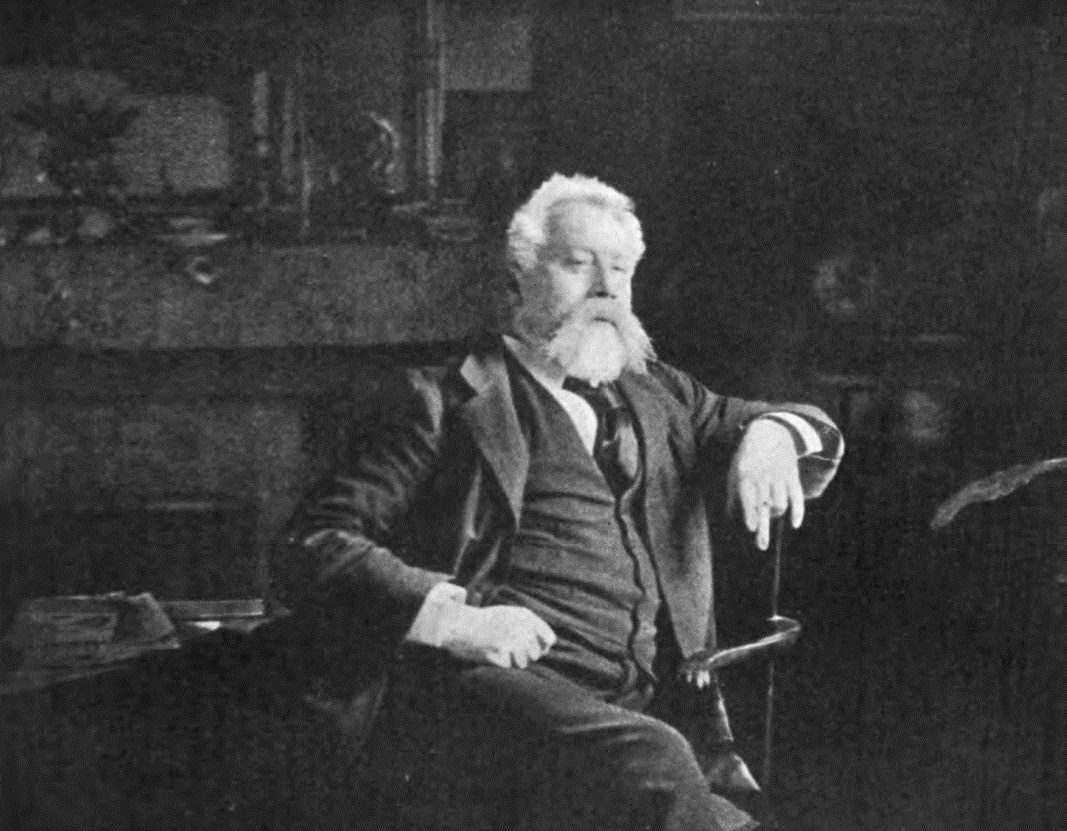
At a Glance
- Born
- August 23, 1849, Gloucester, England
- Died
- July 11, 1903, Woking, Surrey, England (age 53)
- Era
- Victorian
- Known for
- “Invictus,” In Hospital, A Book of Verses, and his work as an editor
- Education
- The Crypt School, Gloucester
- Occupation
- Poet, editor, critic, and playwright
- Spouses
- Anna Boyle (married 1878)
- Honors
- LL.D., University of St Andrews (1893)
- Buried
- Cockayne Hatley churchyard, Bedfordshire (ashes)
ON THIS PAGE
Why He Matters · Timeline · Life and Career · Poetry and Style · Famous Poems and Books · Legacy · FAQ
Related Poets
Why William Ernest Henley Matters
Henley wrote one of the most quoted poems in English. “Invictus” has been recited by soldiers, prisoners, and athletes for more than a century, and Nelson Mandela recited it to fellow prisoners on Robben Island. Yet most people who know the closing lines could not name their author. The poem has outgrown the man, and the man deserves better, because the life behind it is stranger and larger than any poster suggests.
He also mattered as an editor and as an innovator. His hospital poems, many of them unrhymed, set down the facts of illness with a plainness no English poet had tried, and they are among the earliest sustained free verse in the language. As editor of the Scots Observer and the National Observer, he printed work by Rudyard Kipling, W. B. Yeats, Thomas Hardy, H. G. Wells, and J. M. Barrie, and few editors did more to shape what late-Victorian Britain read.
William Ernest Henley Timeline
These are the key dates in Henley’s life and work.
- 1849
- William Ernest Henley is born in Gloucester on August 23, the eldest son of a bookseller.
- 1861
- He is a pupil at the Crypt School when the poet T. E. Brown becomes its headmaster, and at about 12 he develops tuberculosis of the bone.
- 1868
- His father dies, and around this time his left leg is amputated below the knee.
- 1873
- Told his other leg must be amputated, he goes to Edinburgh in August to be treated by Joseph Lister at the Royal Infirmary.
- 1875
- Still in hospital, he writes the poem later called “Invictus” and meets Robert Louis Stevenson through Leslie Stephen, editor of the Cornhill Magazine.
- 1876
- Some of his hospital poems appear in the Cornhill Magazine.
- 1877
- He moves to London to edit the weekly paper London.
- 1878
- He marries Anna Boyle in Edinburgh in January.
- 1882
- He becomes editor of the Magazine of Art, a post he holds until 1886, and his first play with Stevenson, Deacon Brodie, is staged.
- 1883
- Stevenson publishes Treasure Island, whose Long John Silver is modeled on Henley.
- 1888
- A Book of Verses is published, including the hospital poems and “Invictus,” and his daughter, Margaret, is born. A quarrel ends his close friendship with Stevenson.
- 1889
- He becomes editor of the Scots Observer in Edinburgh, renamed the National Observer when it moves to London in 1891.
- 1891
- He publishes Lyra Heroica, an anthology of heroic verse.
- 1892
- The Song of the Sword and Other Verses is published, including “London Voluntaries.”
- 1893
- The University of St Andrews awards him an honorary doctorate.
- 1894
- Margaret dies at age 5, and he leaves the National Observer to edit the New Review, which he runs until 1898.
- 1896
- His centenary edition of Robert Burns, edited with T. F. Henderson, begins to appear.
- 1898
- He is granted a Civil List pension, and his collected Poems is published.
- 1900
- For England’s Sake, his verse of the Boer War, is published, and Arthur Quiller-Couch prints his hospital poem as “Invictus” in The Oxford Book of English Verse.
- 1901
- He publishes Hawthorn and Lavender and moves to Woking.
- 1902
- He is hurt falling from a moving railway carriage, and his tuberculosis returns.
- 1903
- He dies at Woking on July 11, and his ashes are buried in Margaret’s grave at Cockayne Hatley.
- 1907
- A bronze bust of Henley by Auguste Rodin is unveiled in the crypt of St Paul’s Cathedral.
Life and Career
Henley’s life was shaped by illness from boyhood, and he spent it proving that illness would not define him.
Gloucester and Illness (1849–1873)
Henley was born in Gloucester, the eldest son of a struggling bookseller who died in 1868. At the Crypt School, his headmaster was the Manx poet T. E. Brown, whose presence Henley later described as “like a call from the world outside.” From about the age of 12, he suffered from tuberculosis of the bone, and in his late teens his left leg was amputated below the knee. When the disease spread to his other foot and doctors told him it too would have to come off, he refused and went looking for a better surgeon.
Edinburgh, Lister, and Stevenson (1873–1877)
In August 1873, Henley entered the Royal Infirmary of Edinburgh as a patient of Joseph Lister, the pioneer of antiseptic surgery. He stayed about 20 months, and Lister saved the leg. Henley turned the ward into a writing room, producing the sequence that became In Hospital, and in 1875 he wrote the defiant poem that begins “Out of the night that covers me.” That year the editor Leslie Stephen visited him and brought along a young Scottish writer, Robert Louis Stevenson, who found Henley sitting up in bed “as cheerfully as if he had been in a king’s palace.” The two became close friends.
London and Long John Silver (1877–1888)
Henley moved to London in 1877 to edit a weekly paper, and in January 1878 he married Anna Boyle. He edited the Magazine of Art from 1882 to 1886, where he championed Rodin and Whistler, and he wrote four plays with Stevenson, including Deacon Brodie. Henley was big, bearded, loud, and swung along on a crutch, and Stevenson built the one-legged pirate of Treasure Island (1883) on him, writing that “the idea of the maimed man, ruling and dreaded by the sound, was entirely taken from you.” In 1888, a letter from Henley accusing Stevenson’s wife, Fanny, of plagiarism ended the friendship.
Poet and Editor (1888–1894)
Henley’s first collection, A Book of Verses (1888), gathered the hospital poems, light verse in old French forms, and the lyrics he called “Echoes,” among them the untitled poem later known as “Invictus.” The same year his only child, Margaret, was born. From 1889, he edited the Scots Observer, which became the National Observer, and gathered around it a circle of young contributors nicknamed the “Henley Regatta.” He was combative and exacting, but he published Kipling, Yeats, Hardy, Wells, and Barrie, and he was generous with praise for writers he believed in.
Grief and the Last Years (1894–1903)
In 1894, Margaret died at the age of 5, a loss Henley never got over. J. M. Barrie, a family friend, used her as the model for a child in Sentimental Tommy, and she is widely said to have inspired the name Wendy in Peter Pan. Henley edited the New Review until 1898, prepared a centenary edition of Robert Burns, and wrote increasingly public, patriotic verse during the Boer War. In 1902, he fell from a moving railway carriage, and the shock revived his tuberculosis. He died at Woking on July 11, 1903, and his ashes were placed in his daughter’s grave at Cockayne Hatley in Bedfordshire.
Poetry and Style
Henley’s best work is his most direct. The In Hospital poems describe the anesthetic, the surgeon, the other patients, and the dull routine of the ward in short, unrhymed lines that read like notes from a sickbed, and they anticipate the free verse of the next century. “Invictus” is the opposite in form, four tight rhymed quatrains, but the same in spirit: it states its defiance without decoration.
He was also a skilled craftsman in fixed forms, writing ballades, rondeaus, and villanelles, and his “London Voluntaries” are long, musical impressions of the city. His weakness was bluster. The imperial poems of his later years, such as “Pro Rege Nostro,” with its refrain “England, my England,” thrilled readers at the time but now sound like trumpets rather than poems, and modern taste has been far kinder to the quiet hospital sketches.
Famous Poems and Books
These are the works most readers meet first.
- Invictus (1888): Written in hospital in 1875, a four-stanza refusal to be broken that ends “I am the captain of my soul.”
- In Hospital (1888): A sequence of poems from his months in the Edinburgh infirmary, and one of the earliest experiments in English free verse.
- A Book of Verses (1888): His first collection, with the hospital poems, “Invictus,” and the calm evening lyric “Margaritae Sorori.”
- The Song of the Sword and Other Verses (1892): His second collection, including the city poems “London Voluntaries.”
- For England’s Sake (1900): Patriotic verse of the Boer War, including “Pro Rege Nostro” (“England, my England”).
- Hawthorn and Lavender (1901): A late lyric sequence tracing the seasons of a man’s life.
Reputation and Legacy
In his lifetime, Henley was admired more as a critic and editor than as a poet. George Meredith called him “one of the main supports of good literature in our time,” and in 1907 his friends placed a bronze bust of him by Rodin in the crypt of St Paul’s Cathedral. His reputation as a poet faded with the Victorian imperial mood, and today he is remembered for a handful of poems, the hospital sequence above all, and for his role in the careers of other writers.
“Invictus” has had a life of its own. Arthur Quiller-Couch gave it its Latin title, meaning “unconquered,” in The Oxford Book of English Verse (1900). Nelson Mandela recited it to fellow prisoners on Robben Island, and Clint Eastwood’s 2009 film Invictus, about Mandela and South Africa’s 1995 Rugby World Cup team, took its name from the poem. Long John Silver and, many believe, Wendy Darling carry traces of Henley’s household into two of the best-loved children’s books ever written.
Frequently Asked Questions
These are the questions people most often ask about William Ernest Henley.
Who was William Ernest Henley?
William Ernest Henley (1849–1903) was an English poet, editor, and critic, best known for the poem “Invictus.” He lost a leg to tuberculosis, edited several influential magazines, and was the model for Long John Silver in Robert Louis Stevenson’s Treasure Island.
Why did William Ernest Henley write “Invictus”?
He wrote it in 1875 in an Edinburgh hospital, where he was being treated for tuberculosis of the bone after losing one leg and fighting to save the other. The poem is his refusal to be broken by that suffering.
How did William Ernest Henley die?
He died of tuberculosis at Woking, Surrey, on July 11, 1903, at age 53. A fall from a moving railway carriage in 1902 had brought back the disease he had lived with since childhood.
How did William Ernest Henley lose his leg?
Tuberculosis of the bone, which he developed at about 12, forced the amputation of his left leg below the knee in his late teens. When the disease threatened his other leg, the surgeon Joseph Lister saved it at the Royal Infirmary of Edinburgh.
Was William Ernest Henley the inspiration for Long John Silver?
Yes. Robert Louis Stevenson told Henley that the idea of the maimed pirate in Treasure Island “was entirely taken from you,” drawing on Henley’s size, energy, and commanding personality.
Related Poets
These poets shaped Henley or were shaped by him.
- Robert Louis Stevenson: His closest friend and collaborator, who modeled Long John Silver on him.
- Rudyard Kipling: A young writer Henley published and championed, and a fellow poet of empire.
- W. B. Yeats: An early contributor to Henley’s National Observer, who later wrote fondly of him as a mentor.
- T. E. Brown: The Manx poet and schoolmaster who first encouraged Henley’s writing.
- Robert Burns: The Scottish poet whose centenary edition Henley co-edited, with a famously frank critical essay.