QUICK FACTS
Born: 25 January 1759, Alloway, Ayrshire, Scotland
Died: 21 July 1796 (aged 37), Dumfries, Scotland
Era: Romantic (pre-Romantic / early Romantic)
Occupation: Poet, lyricist, songwriter, tenant farmer, exciseman
Education: Tutored at home by John Murdoch; largely self-taught
Known for: National Bard of Scotland; “Auld Lang Syne,” “Tam o’ Shanter,” and “A Red, Red Rose”
Robert Burns is Scotland’s national poet, and the title is no sentimental inflation. He took the spoken Scots of Ayrshire farm kitchens — a tongue the literary establishment of his day treated as too coarse for print — and proved it could carry tenderness, savage satire, political conviction, and song that the whole world would eventually sing. In a single decade he turned a regional dialect into a literature.
His life was short and crowded. He rose from a failing tenant farm to literary celebrity in Edinburgh, poured years of unpaid labour into rescuing and rewriting Scotland’s folk songs, and died worn out at thirty-seven. He left behind hundreds of poems and songs, among them “Auld Lang Syne,” now sung at the turning of nearly every year on earth, and an annual celebration — Burns Night — held in his honour wherever Scots have settled.
ON THIS PAGE
From the Ayrshire Soil · The Kilmarnock Edition and Sudden Fame · Edinburgh and the Song Collector · Farming, Marriage, and the Excise · Radical Politics and Final Years · Style, Voice, and Lasting Influence · Notable Poems · Frequently Asked Questions · Related Poets
From the Ayrshire Soil
Burns was born on 25 January 1759 in a clay-walled cottage at Alloway, two miles south of Ayr, built by his own father. William Burnes — the older spelling Robert later simplified — was a tenant farmer who scraped a hard living but cared fiercely about his children’s minds. He hired a young tutor, John Murdoch, to teach Robert and his brother Gilbert grammar, English literature, and a little French and Latin. From his mother, Agnes Broun, and an elderly family servant, the boy absorbed the other half of his education: the Scots ballads, songs, and tales that would feed his work for the rest of his life.
The cost of that upbringing was physical. Burns worked the fields like a grown man from boyhood, and the strain of heavy labour on poor, exhausted ground marked his health permanently. The family moved from farm to struggling farm — Mount Oliphant, then Lochlea — always one bad harvest from ruin. When William died in 1784, broken by debt and toil, Robert and Gilbert took on the farm at Mossgiel, where, between the plough handles, Robert was already filling notebooks with verse.
The Kilmarnock Edition and Sudden Fame
By 1786 Burns was cornered. The Mossgiel farm was failing, his relationship with Jean Armour had produced twins and the furious opposition of her father, and he had resolved on a desperate escape: emigration to Jamaica to take a clerk’s post on a sugar plantation. To raise the passage money, he gathered his poems and published them. Poems, Chiefly in the Scottish Dialect appeared from a Kilmarnock printer in July 1786.
It was an instant sensation. The small print run sold out within weeks, copies passing from hand to hand across Ayrshire and beyond, and the Edinburgh literary world took startled notice of this unknown farmer who wrote with such wit and feeling. The emigration tickets were never used. Almost overnight, Burns had a reputation and a reason to stay in Scotland.
Edinburgh and the Song Collector
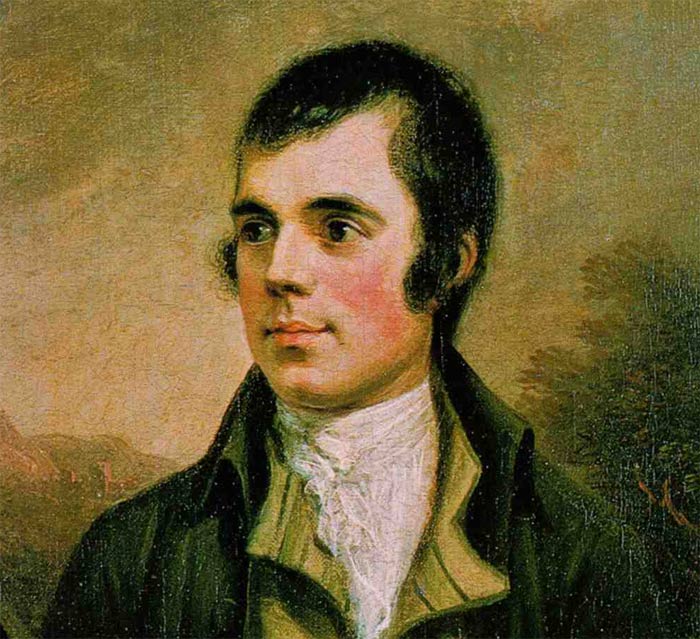
In the winter of 1786 Burns travelled to Edinburgh, where polite society received him as a marvel — the “heaven-taught ploughman,” a natural genius sprung from the soil. The label flattered and confined him at once. The capital produced the expanded 1787 Edinburgh Edition, published by William Creech, with Alexander Nasmyth’s portrait engraved as its frontispiece.
The deeper work of these years was quieter and almost entirely unpaid. Burns threw himself into collecting, repairing, and rewriting Scotland’s traditional songs, contributing hundreds to James Johnson’s Scots Musical Museum and later to George Thomson’s Select Collection of Original Scottish Airs. He refused payment, treating the songs as a national inheritance rather than private property. Much of what the world now hears as anonymous Scottish folk music — “Auld Lang Syne,” “A Red, Red Rose,” “Ae Fond Kiss,” “Scots Wha Hae” — is in fact Burns reshaping old fragments into finished art.
Farming, Marriage, and the Excise
After years of obstruction, Burns and Jean Armour finally married in 1788. The marriage anchored a famously tangled romantic life — Burns fathered twelve children across various relationships — but Jean remained the centre of it, and several of his finest love songs were written for her.
He tried farming once more, taking the lease at Ellisland near Dumfries in 1788, and once more the land defeated him. To support his growing family he trained as an exciseman, a collector of duties on goods, and in 1791 gave up Ellisland to move into Dumfries and work the Excise full time. It was the first steady income of his life, earned by long days riding the district, and it left less and less time for poetry.
Radical Politics and Final Years
Burns held egalitarian convictions that ran ahead of his age. He sympathised openly with the American and then the French Revolutions, and his belief that worth lies in character rather than rank found its plainest expression in “A Man’s a Man for A’ That.” That radicalism became dangerous for a man drawing a government wage as Britain went to war with revolutionary France; Burns had to temper his public statements to protect his post, and in 1795 he joined the Royal Dumfries Volunteers.
His body, strained since childhood and likely weakened by rheumatic heart disease, gave out early. Burns died in Dumfries on 21 July 1796 at the age of thirty-seven, days before Jean gave birth to their last child. Thousands attended his funeral. The poet who had nearly sailed off into obscurity a decade earlier was buried as a national figure.
Style, Voice, and Lasting Influence
What sets Burns apart is the range he wrung from a language others dismissed. He could be tender, ribald, furious, and funny within a single page, and he moved between Scots and English with deliberate purpose. Three strands of his achievement are worth separating out.
A Poet of Scots and English
Burns code-switched like a master. He reached for broad Scots when he wanted warmth, intimacy, or satirical bite — the voice that speaks directly to a field mouse or a louse on a churchgoer’s bonnet — and for formal English when he wanted elevation. His favourite verse form, the six-line “standard Habbie” stanza, became so identified with him that it is now simply called the Burns stanza. The hallmark throughout is directness and an instinctive sympathy that refuses to look down on its subjects.
The Songs That Outlived Him
Burns’s decision to give his songs away rather than sell them is one of the great acts of literary generosity. He poured his best lyric instincts into reviving a tradition that was slipping out of memory, and the result is that his words now circle the globe detached from his name. “Auld Lang Syne” is sung at New Year on every continent, and millions who could not name its author are, in effect, quoting Robert Burns.
Scotland’s National Bard
Every 25 January, his birthday, Burns suppers are held worldwide — the haggis piped in and addressed with his “Address to a Haggis,” his songs sung, his memory toasted. His reach extends well past Scotland: he is a claimed ancestor of Romantic poetry who influenced Wordsworth, and later writers mined him for titles, John Steinbeck’s Of Mice and Men taking its name from “To a Mouse” and J. D. Salinger’s The Catcher in the Rye from “Comin’ Thro’ the Rye.” Few poets have lodged themselves so deeply in ordinary speech and ritual.
Notable Poems
- Auld Lang Syne: The song of parting and remembrance sung worldwide at the turn of the year, reworked by Burns from older fragments.
- Tam o’ Shanter: A galloping comic narrative of a drunk farmer’s midnight ride past a witches’ revel, widely held to be his masterpiece.
- To a Mouse: Tender, rueful lines to a mouse whose nest his plough has destroyed, source of the proverb about the best-laid plans.
- A Red, Red Rose: A love song of extravagant constancy, built from traditional ballad material into something wholly his own.
- Address to a Haggis: The mock-heroic ode to Scotland’s national dish, recited at every Burns supper.
- Scots Wha Hae: A martial anthem in the voice of Robert the Bruce, long treated as an unofficial Scottish national song.
- A Man’s a Man for A’ That: His clearest statement of egalitarian conviction, insisting that honest worth outranks title and wealth.
Frequently Asked Questions
What Is Robert Burns Best Known For?
Burns is best known as Scotland’s national poet and as the author of poems and songs that crossed into global culture, including “Auld Lang Syne,” “Tam o’ Shanter,” “A Red, Red Rose,” and “To a Mouse.” He is also famous for writing in Scots and for the worldwide Burns Night celebrations held on his birthday.
Did Robert Burns Write “Auld Lang Syne”?
Largely, yes. Burns took an older Scots fragment and reshaped it into the version sung today, sending it to the Scots Musical Museum in 1788. He always credited the song to tradition, but the form the world knows is essentially his.
Why Is Robert Burns Called Scotland’s National Poet?
Because he gave literary dignity to the Scots language, preserved and revived a vast body of Scottish song, and voiced a democratic, distinctly Scottish sensibility that the nation embraced as its own. His birthday is marked across the country and the wider Scottish diaspora.
What Is Burns Night?
Burns Night is the annual celebration of the poet on his birthday, 25 January. A traditional Burns supper features haggis piped to the table and honoured with his “Address to a Haggis,” followed by recitations, songs, and toasts to his memory.
What Language Did Robert Burns Write In?
Burns wrote in both Scots and English, often moving between them within a single work. He used broad Scots for warmth, humour, and satire, and formal English for more elevated passages, a combination that gives his verse its distinctive texture.
Related Poets
- Robert Fergusson: The young Edinburgh poet whose Scots verse Burns revered as a direct model and forerunner.
- Allan Ramsay: The earlier Scots vernacular poet and song collector who helped clear the path Burns would walk.
- William Wordsworth: The English Romantic who admired Burns and praised the ploughman-poet who found glory behind his plough.
- John Clare: The English rural labourer-poet whose plain-spoken love of the countryside echoes Burns’s own.
- Walter Scott: The Scottish novelist and poet who met Burns as a boy and carried Scotland’s literary voice into the next generation.