QUICK FACTS
Born: November 28, 1757 · Soho, London, England
Died: August 12, 1827 · London, England (aged 69)
Era: Romanticism
Occupation: Poet; painter; engraver
Education: Apprenticed to engraver James Basire; Royal Academy (briefly)
Known for: “The Tyger”; Songs of Innocence and of Experience
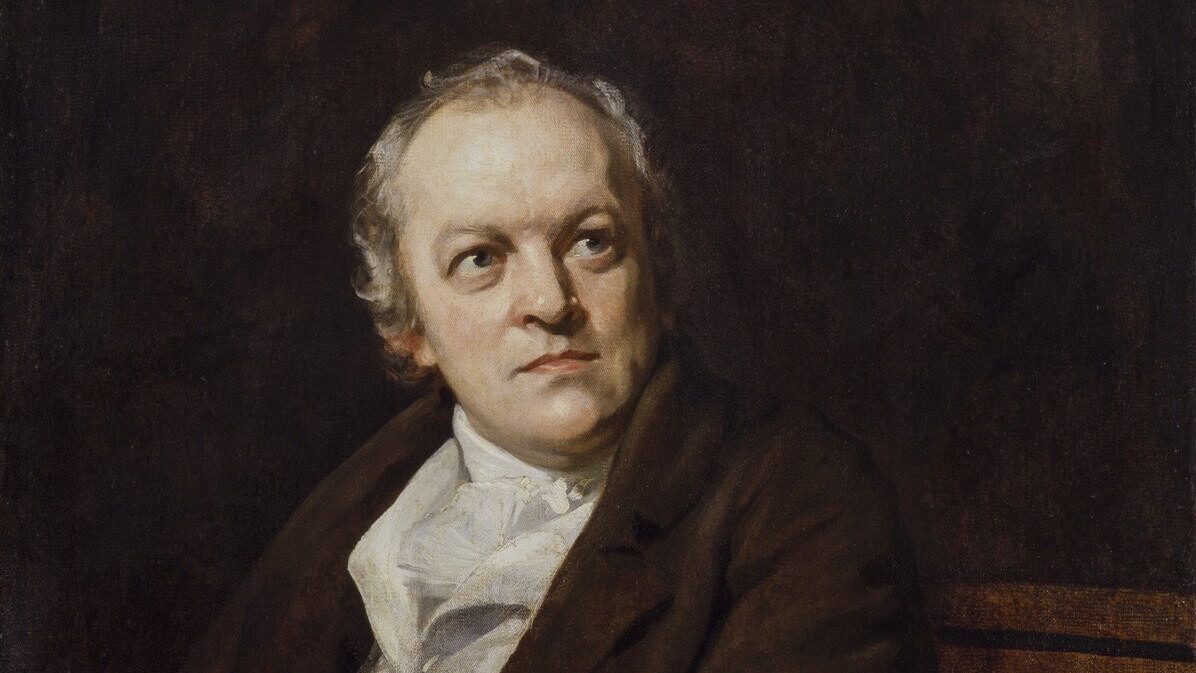
William Blake (1757–1827) was an English poet, painter, and engraver — a visionary who stands at the threshold of Romanticism and entirely apart from it. Largely ignored or thought mad in his lifetime, he is now recognized as one of the most original artists in English history, a maker of poems and pictures fused into a single, hand-crafted whole.
Blake reported seeing visions from childhood and built from them a vast personal mythology of innocence and experience, energy and restraint, tyranny and spiritual freedom. From the deceptively simple “The Tyger” to his sprawling prophetic books, his work insists that imagination is not fantasy but the deepest truth — “the divine body in every man.”
On This Page: Early Life and Education · Literary Career and Major Works · Style and Themes · Later Life and Legacy · Notable Poems · Frequently Asked Questions · Related Poets
Early Life and Education
Blake was born on November 28, 1757, in Soho, London, the son of a modest hosier. He had almost no formal schooling, but his artistic gift was clear early, and as a boy he was sent to drawing school and then, at fourteen, apprenticed to the engraver James Basire — training that gave him both a craft and a livelihood. He studied briefly at the Royal Academy but recoiled from its conventions.
From childhood, Blake claimed to see visions — angels in a tree, prophets in the street — and he treated them not as delusions but as glimpses of spiritual reality. His real education came from his own imagination and from voracious reading, above all the Bible, Milton, and the radical thinkers of his revolutionary age.
Literary Career and Major Works
Blake’s greatest innovation was to make poet and printer, writer and artist, one. His first collection, Poetical Sketches (1783), showed an original lyric voice, but his mature genius emerged in the 1790s through “illuminated printing” — a method he devised for engraving text and image together on copper and hand-coloring each page. By it, he produced Songs of Innocence (1789) and Songs of Experience (1794), later issued together as a single work tracing the soul’s passage from purity through suffering.
The same revolutionary decade brought The Marriage of Heaven and Hell (1790–93), which overturned settled ideas of good and evil, and the political prophecies America (1793) and Europe (1794). In his later years he built an entire mythology in the long prophetic books Milton (1804–08) and Jerusalem (1804–20).
Style and Themes
No English poet is at once so simple and so strange as Blake. His lyrics can sound like nursery rhymes, yet they carry the weight of scripture and prophecy. His central cause was the liberation of the human spirit — freedom from tyranny, dogma, and the “mind-forged manacles” of convention — and his central method was contrast: innocence against experience, the lamb against the tiger, energy against restraint.
He held that imagination was the very substance of reality and the material world only its shadow, and he filled his pages with archetypal symbols drawn from the Bible, myth, and his own visionary cosmos. That fusion of childlike clarity and prophetic grandeur places him among the most singular voices in the language.
Later Life and Legacy
Blake lived and died in poverty and near-obscurity. In 1782, he married Catherine Boucher, who became his devoted companion, assistant, and fellow printer. For most of his life he worked in isolation, dismissed by many as eccentric or mad, sustained by his art and a small circle of younger admirers such as Samuel Palmer, who revered him as a prophet.
He died in London on August 12, 1827 — by tradition singing and sketching to the last — and was buried in an unmarked grave in Bunhill Fields, the burial ground of dissenters. Only long afterward did the world grasp his stature.
Today, Blake is seen as a bridge between the Enlightenment and the modern world, and his influence reaches from the Romantics to W. B. Yeats and Allen Ginsberg, and far beyond poetry into painting, music, and visionary thought.
Notable Poems
These are the Blake poems most worth starting with:
- The Tyger: His most famous poem — from Songs of Experience, a hypnotic, awestruck address to the tiger and the dread power that could have made it.
- The Lamb: Its gentle companion in Songs of Innocence, a child’s tender question and answer about who made the lamb.
- London: A searing vision of the suffering, oppressed city and its “mind-forged manacles.”
- Songs of Innocence and of Experience: His illuminated masterpiece, setting poems of childhood purity against poems of corruption and pain.
- The Marriage of Heaven and Hell: A daring prose-and-verse work overturning conventional ideas of good and evil, reason and energy.
- And Did Those Feet in Ancient Time: The visionary lyric from the preface to Milton, now sung across Britain as the hymn “Jerusalem.”
Frequently Asked Questions
Quick answers to the questions readers most often ask about William Blake.
What is William Blake best known for?
His visionary poetry and art, especially “The Tyger” and the paired collections Songs of Innocence and of Experience, and his unique “illuminated” books that combine his own poems and engravings.
What is “The Tyger” about?
A short, incantatory poem that gazes at the tiger’s fearsome beauty and asks what kind of creator could have made it — “Did he who made the Lamb make thee?” It is Blake’s most famous poem and the dark companion to “The Lamb.”
Was William Blake a painter as well as a poet?
Yes. Blake was a trained engraver and a major visual artist; he printed his poems himself in “illuminated printing,” engraving and hand-coloring text and pictures together on the same page.
Why was Blake considered mad?
He described seeing visions throughout his life and built an unconventional personal mythology, which led many contemporaries to dismiss him as eccentric or insane. Later generations recognized him instead as a profoundly original genius.
What are the main themes in Blake’s poetry?
Imagination as the source of truth, the contrast between innocence and experience, spiritual and political freedom, and rebellion against oppression, dogma, and “mind-forged manacles.”
Related Poets
Readers who admire Blake often turn to these poets:
- Samuel Taylor Coleridge: A fellow Romantic visionary equally drawn to symbol, prophecy, and the imagination.
- William Wordsworth: The great first-generation Romantic, who admired Blake’s Songs even while puzzling over him.
- Percy Bysshe Shelley: A younger Romantic radical who shared Blake’s hatred of tyranny and faith in imaginative renewal.
- W. B. Yeats: A modern visionary poet who edited Blake and drew deeply on his symbolism and mythology.
- Allen Ginsberg: A 20th-century poet who claimed a Blake vision as his awakening and carried his prophetic voice into the modern age.