Lewis Carroll (1832–1898) was an English poet best known for “Jabberwocky,” the 28-line nonsense ballad he published in Through the Looking-Glass in 1871. Carroll was the pen name of Charles Lutwidge Dodgson, a mathematics lecturer at Christ Church, Oxford, who also wrote Alice’s Adventures in Wonderland (1865), The Hunting of the Snark (1876), and dozens of comic poems, many of them parodies now better known than the verses they mocked.
Our view: Carroll was a logician who played with language the way other mathematicians play with numbers. His nonsense is never random. It keeps the grammar, meter, and rhyme of ordinary English and swaps out the meaning, which is why children can recite it and philosophers still quote it. He treated verse as a game with strict rules, and he won it more completely than anyone before him.
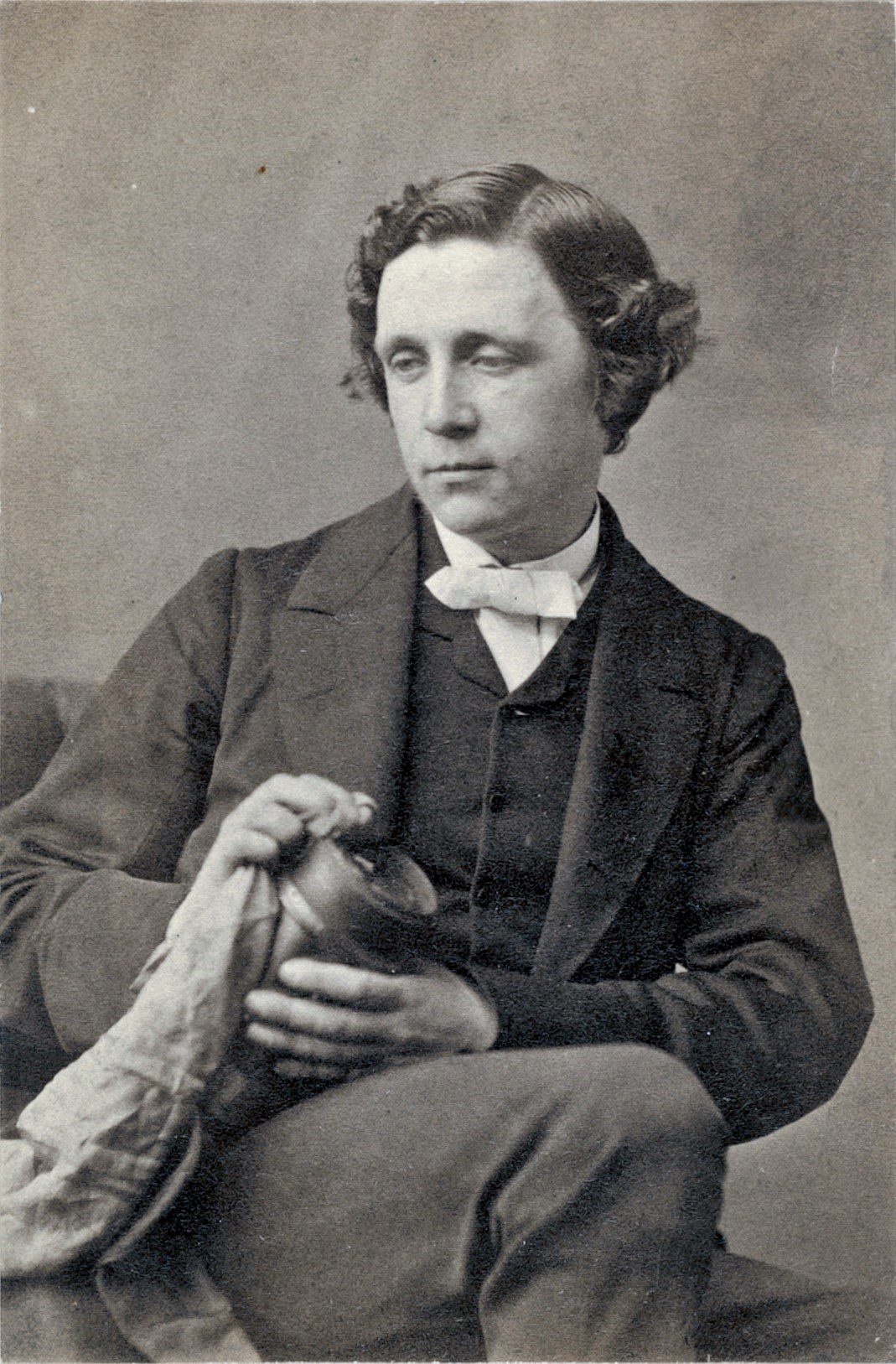
At a Glance
- Born
- January 27, 1832, Daresbury, Cheshire, England
- Died
- January 14, 1898 (aged 65), Guildford, Surrey, England
- Era
- Victorian
- Known for
- “Jabberwocky,” the two Alice books, and The Hunting of the Snark
- Education
- Richmond School; Rugby School; Christ Church, Oxford (B.A., 1854)
- Occupation
- Mathematician, Oxford lecturer, Anglican deacon, photographer, and writer
- Buried
- The Mount Cemetery, Guildford, Surrey
ON THIS PAGE
Why He Matters · Timeline · Life and Career · Poetry and Style · Famous Poems and Books · Legacy · FAQ
Related Poets
Why Lewis Carroll Matters
Carroll turned nonsense into a serious art. Before him, English nonsense verse was mostly nursery rhyme and comic doggerel. He showed that a poem could be made almost entirely of invented words and still tell a clear story, and that a parody could outlive its original. His “Jabberwocky” gave English the words “chortle” and “galumph,” and his idea of the “portmanteau” word, two meanings packed into one, became a standard term in linguistics.
He also changed what a children’s book could be. The Alice books have no moral lesson, and they poke fun at the improving verses Victorian children were made to memorize. Their mix of logic puzzles, wordplay, and dream has made them some of the most quoted books in English, read as closely by philosophers, mathematicians, and linguists as by children.
Lewis Carroll Timeline
These are the key dates in Carroll’s life, from a Cheshire parsonage to Oxford, Wonderland, and the Snark.
- 1832
- Born Charles Lutwidge Dodgson on January 27 at the parsonage in Daresbury, Cheshire, the eldest son among 11 children.
- 1843
- His family moves to Croft-on-Tees in North Yorkshire, where his father becomes rector.
- 1846
- He enters Rugby School, where he stays until 1849.
- 1851
- He arrives at Christ Church, Oxford, in January, and his mother dies only days later.
- 1854
- He graduates with first-class honors in mathematics.
- 1855
- He becomes Mathematical Lecturer at Christ Church and writes the stanza that will open “Jabberwocky” in the family magazine Mischmasch.
- 1856
- He first uses the name Lewis Carroll, for the poem “Solitude” in the magazine The Train, and takes up photography.
- 1861
- He is ordained a deacon of the Church of England on December 22.
- 1862
- On July 4, during a boat trip on the Thames, he tells Alice Liddell and her sisters the story that becomes Wonderland.
- 1864
- He gives Alice the handwritten and illustrated manuscript Alice’s Adventures Under Ground.
- 1865
- Macmillan publishes Alice’s Adventures in Wonderland, illustrated by John Tenniel.
- 1867
- He travels to Russia with Henry Liddon, his only journey outside Britain.
- 1869
- He publishes Phantasmagoria and Other Poems.
- 1871
- Through the Looking-Glass appears in December, with “Jabberwocky” and “The Walrus and the Carpenter.”
- 1876
- He publishes The Hunting of the Snark, a nonsense poem in eight “fits.”
- 1879
- He publishes Euclid and His Modern Rivals, a defense of Euclid as a school textbook.
- 1880
- He gives up photography after taking some 3,000 pictures.
- 1881
- He resigns his mathematical lectureship after 26 years.
- 1882
- He becomes Curator of the Senior Common Room at Christ Church, a post he holds until 1892.
- 1889
- He publishes Sylvie and Bruno, followed by Sylvie and Bruno Concluded in 1893.
- 1896
- He publishes Symbolic Logic, Part I.
- 1898
- Dies of pneumonia on January 14 at his sisters’ home in Guildford, Surrey.
Life and Career
Dodgson lived almost his whole adult life inside one Oxford college. The quiet mathematician and the playful author were the same man, and the two sides fed each other.
A Rectory Childhood (1832–1850)
Charles Lutwidge Dodgson was born on January 27, 1832, at the parsonage in Daresbury, Cheshire, the eldest son of the Reverend Charles Dodgson and Frances Jane Lutwidge. In 1843, the family moved to Croft-on-Tees in North Yorkshire. With seven sisters and three brothers, he became the family entertainer, writing puppet plays and producing handwritten magazines full of poems, parodies, and drawings.
He was educated at Richmond School and then at Rugby School from 1846 to 1849, which he disliked. He had a stammer all his life and, after a childhood fever, was deaf in one ear.
Oxford and a New Name (1851–1861)
Dodgson arrived at Christ Church, Oxford, in January 1851, and his mother died only days later. He took first-class honors in mathematics in 1854, and in 1855 he became the college’s Mathematical Lecturer, a post he held for 26 years. That summer, in the family magazine Mischmasch, he wrote a mock “Stanza of Anglo-Saxon Poetry” that would later open “Jabberwocky.”
In 1856, the editor Edmund Yates chose the pen name Lewis Carroll from a list Dodgson sent him. It came from his first two names: Charles Lutwidge became the Latin Carolus Ludovicus, which he turned around and translated back into English. The same year, he took up photography, and over the next 24 years he made some 3,000 pictures, including portraits of Alfred Tennyson and the Rossetti family. He was ordained a deacon in 1861 but never became a priest.
Alice (1862–1871)
On July 4, 1862, Dodgson and his friend Robinson Duckworth rowed the three daughters of Henry Liddell, the dean of Christ Church, up the Thames toward Godstow. To pass the time, he told them a story about a girl named Alice who falls down a rabbit hole. Ten-year-old Alice Liddell asked him to write it down, and in November 1864 he gave her a handwritten, self-illustrated copy called Alice’s Adventures Under Ground. His friendship with the Liddell family ended abruptly in June 1863; the diary pages covering those days were later removed by a relative, and the reason for the break is still unknown.
An expanded version, Alice’s Adventures in Wonderland, was published by Macmillan in 1865 with illustrations by John Tenniel. The first printing was withdrawn because Tenniel disliked its quality, but the reissued book was a success, and in December 1871 Carroll followed it with Through the Looking-Glass, and What Alice Found There. Between the two books he published Phantasmagoria and Other Poems (1869), and in 1867 he made his only trip abroad, traveling to Russia with his friend Henry Liddon.
Snarks, Logic, and Sylvie (1872–1898)
Carroll’s longest nonsense poem, The Hunting of the Snark, appeared in 1876, subtitled “An Agony in Eight Fits.” He kept writing mathematics under his real name, including Euclid and His Modern Rivals (1879), and puzzle books such as A Tangled Tale (1885) and The Game of Logic (1886). He gave up photography in 1880, resigned his lectureship in 1881, and served as Curator of the Senior Common Room at Christ Church from 1882 to 1892.
His last major fiction, Sylvie and Bruno (1889) and Sylvie and Bruno Concluded (1893), mixed fairy tale, sermon, and nonsense verse, and never matched the Alice books. In 1896, he published Symbolic Logic, Part I. He died of pneumonia, after influenza, on January 14, 1898, at The Chestnuts, his sisters’ home in Guildford, Surrey, and was buried in the town’s Mount Cemetery. He never married.
Poetry and Style
Carroll’s best poems are built on strict forms. He used ballad stanzas, regular meters, and firm rhyme, and then filled them with invented words, impossible logic, or deadpan absurdity. Because the form is so steady, readers can follow the story even when the words make no sense, and that tension between order and chaos is the source of his comedy.
Parody was his other great tool. Many of the Alice poems send up verses that Victorian children learned by heart: “How Doth the Little Crocodile” mocks Isaac Watts’s busy bee, “You Are Old, Father William” mocks Robert Southey’s pious old man, and “Twinkle, Twinkle, Little Bat” mocks Jane Taylor’s star. Today, the parodies are far better known than the originals.
His weakness was his serious verse. When Carroll tried to be tender or devout, as in many poems in Phantasmagoria and the sentimental parts of Sylvie and Bruno, he often slipped into Victorian sweetness. His genius needed a game to play, and without one, his poems lose their spark.
Famous Poems and Books
Carroll wrote poems, stories, puzzles, and mathematics. These are the works readers should know first.
- Jabberwocky (1871): The nonsense ballad of a boy who slays the Jabberwock, and the source of “chortle” and “galumph.”
- The Walrus and the Carpenter (1871): Tweedledee’s tale of two companions who charm a bed of young oysters and then eat them.
- You Are Old, Father William (1865): A comic dialogue between a curious youth and a surprisingly athletic old man.
- How Doth the Little Crocodile (1865): A short parody that turns a hymn about the busy bee into a smiling predator.
- The Hunting of the Snark (1876): A long nonsense poem about a crew hunting a creature no one can describe.
- Alice’s Adventures in Wonderland (1865): The dream story that grew from a boat trip with the Liddell sisters.
- Through the Looking-Glass, and What Alice Found There (1871): The sequel, built on a game of chess, with many of his best poems.
- Phantasmagoria and Other Poems (1869): His first collection of verse, comic and serious.
- Sylvie and Bruno (1889 and 1893): A two-part novel mixing fairy tale, philosophy, and nonsense songs.
Reputation and Legacy
The Alice books have never been out of print, have been translated into well over a hundred languages, and have been adapted for stage and screen many times, most famously in Disney’s 1951 animated film. Carroll’s coinages entered the dictionary, the surrealists claimed him as a forerunner, and philosophers and logicians still borrow his examples. The original manuscript of Alice’s Adventures Under Ground is now in the British Library.
His private life has drawn more scrutiny. Dodgson’s friendships with young girls and his photographs of children, a few of them unclothed and taken with their parents’ permission, have led some modern writers to question his motives. There is no evidence that he harmed any child, and biographers remain divided over how to read his friendships. The debate has not dimmed his standing as the greatest writer of nonsense in English.
Frequently Asked Questions
These are the questions readers most often ask about Lewis Carroll.
What Was Lewis Carroll’s Real Name?
His real name was Charles Lutwidge Dodgson. The pen name Lewis Carroll came from turning his first two names into Latin, Carolus Ludovicus, reversing them, and translating them back into English.
Why Did Lewis Carroll Write Alice in Wonderland?
He wrote it for Alice Liddell, the daughter of the dean of his Oxford college, after telling her and her sisters the story during a boat trip on July 4, 1862. She asked him to write it down, and he gave her a handwritten version in 1864 before expanding it for publication in 1865.
Was Lewis Carroll a Pedophile?
There is no evidence that he abused any child. The question comes from his close friendships with young girls and his photographs of children, and biographers disagree about his feelings: some suspect repressed attraction, while others argue that this reading ignores his many adult friendships and the Victorian view of childhood.
What Disability Did Lewis Carroll Have?
He had a stammer all his life and was deaf in one ear after a childhood fever. Modern writers have also speculated about migraine or autism, but neither was ever diagnosed.
How Did Lewis Carroll Die?
He died of pneumonia, following influenza, on January 14, 1898, at his sisters’ home in Guildford, Surrey. He was 65 and is buried in the Mount Cemetery in Guildford.
Related Poets
These poets shared Carroll’s love of nonsense, sat for his camera, or wrote the verses he parodied.
- Edward Lear: The other great Victorian master of nonsense verse, author of “The Owl and the Pussy-cat.”
- Alfred Tennyson: The poet laureate Carroll admired and photographed, whose grand manner his nonsense sometimes echoes.
- Christina Rossetti: A Victorian poet of fantasy and childhood whom Carroll photographed with her family.
- Isaac Watts: The hymn writer whose “Against Idleness and Mischief” Carroll turned into “How Doth the Little Crocodile.”
- Robert Southey: The Romantic poet whose “The Old Man’s Comforts” became “You Are Old, Father William.”