QUICK FACTS
Born: 18 March 1893, Oswestry, Shropshire, England
Died: 4 November 1918 (aged 25), near Ors, France
Era: Modernist (War Poetry)
Occupation: Poet; soldier, Manchester Regiment
Education: Birkenhead Institute and Shrewsbury Technical School
Known for: The major English poetry of the First World War
Wilfred Owen is the poet through whom the English-speaking world remembers the First World War. More than any of his contemporaries, he fixed the image of that conflict not as a clash of empires or a test of national honour but as an obscene waste of the young — gas, mud, and the slow extinction of a generation rendered in lines too precise to look away from. He did it in barely two years of mature work, most of it written in a single creative burst, by a soldier who fully expected to die and did.
That he became this figure at all is one of the stranger accidents of literary history. Owen was almost unknown when he was killed in action on 4 November 1918, a week before the Armistice; only five of his poems had appeared in print. The telegram announcing his death reached his mother on Armistice Day, as the church bells rang for peace. The reputation came afterward — assembled by friends, editors, and composers across the twentieth century until Owen stood, by common consent, as the central English poet of the war.
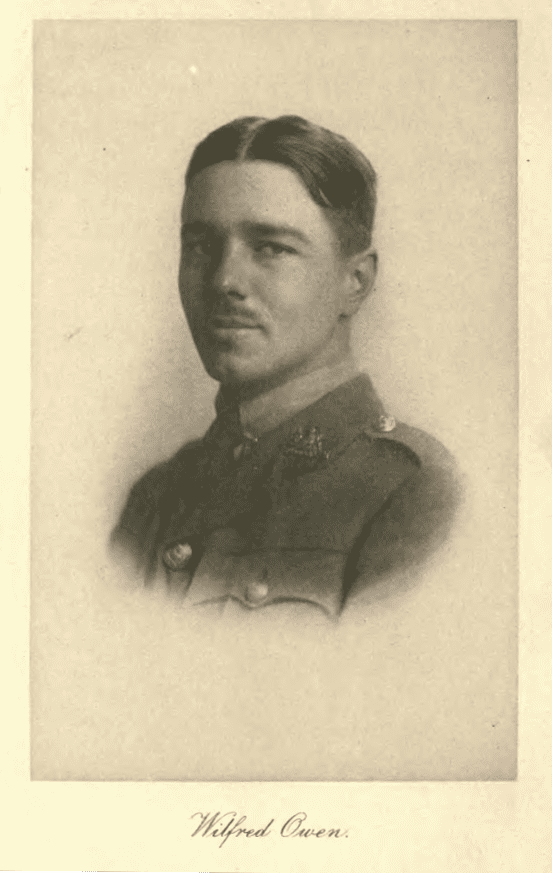
ON THIS PAGE
Early Life and Education · A Crisis of Faith · Soldier and Poet · The Poetry of Pity · Death and Posthumous Fame
Notable Poems · Frequently Asked Questions · Related Poets
Early Life and Education
Wilfred Edward Salter Owen was born on 18 March 1893 at Plas Wilmot, a comfortable house near Oswestry on the Welsh border. The comfort did not last. When his grandfather died and the family money went with him, the Owens moved to cramped lodgings in Birkenhead, and Wilfred grew up in the genteel poverty of a family that remembered better days. His father, Tom, was a railway official with little patience for his son’s literary leanings; his mother, Susan, was devout, possessive, and adoring, and remained the central relationship of Owen’s life — he wrote to her constantly, and many of his finest letters are addressed to her.
Owen discovered poetry early and gave himself to it with a convert’s intensity. Keats was his god, and the lush, sensuous music of Romantic verse marked everything he wrote, even at its most brutal. He was a diligent rather than brilliant student at the Birkenhead Institute and later at Shrewsbury Technical School. The decisive failure of his youth was academic: he sat the entrance examination for the University of London and did not win the scholarship he needed, and without it university lay beyond the family’s means. Owen never got the formal literary education he wanted. He built himself into a poet by reading, imitating, and revising in private.
A Crisis of Faith
Owen’s upbringing was intensely evangelical, and for a time a career in the Church seemed his likeliest future. In 1911 he took an unpaid post as lay assistant to the Vicar of Dunsden in Oxfordshire, expecting the work to confirm his faith. It did the opposite. Confronted daily with the sickness and poverty of the parish poor, Owen came to see the comfortable Anglicanism around him as indifferent to real suffering, and he left in 1913 with his belief in the institutional Church broken — though never his moral seriousness, which simply transferred itself to other objects.
He went next to France, teaching English at the Berlitz school in Bordeaux and then privately with a French family. He was abroad, reading and writing and uncertain of his direction, when the war that would make him broke out. Owen did not rush to enlist. He weighed it for more than a year before returning to England and joining the Artists’ Rifles in October 1915.
Soldier and Poet
The war turned a gifted, derivative young writer into a major poet with terrible speed. Two experiences did the work: the front itself, which gave Owen his subject, and a chance meeting in a hospital, which gave him the manner to treat it.
From Enlistment to the Front
Commissioned into the Manchester Regiment, Owen reached the front line in France at the start of 1917, during one of the worst winters of the war. Within weeks he had been blown into the air by a shell, trapped for days in a flooded dugout, and left sheltering near the scattered remains of a fellow officer. He held on longer than most, but the strain told. Diagnosed with neurasthenia — the shell shock of the period — he was invalided back to Britain in the summer of 1917 and sent to recover at Craiglockhart War Hospital in Edinburgh.
Craiglockhart and Siegfried Sassoon
At Craiglockhart, Owen met Siegfried Sassoon, an established poet already notorious for his public protest against the conduct of the war. The meeting was the hinge of Owen’s career. Sassoon read his work, pushed him toward the plain, savage, anti-heroic register he was developing himself, and treated the unknown younger officer as a peer. Under that encouragement Owen wrote or revised most of the poems he is now famous for, including “Anthem for Doomed Youth,” whose manuscript carries Sassoon’s suggestions in the margins. Owen left the hospital a finished poet, and he never disguised how much he owed the older man.
The Poetry of Pity
Owen set down what he was trying to do in a preface for a collection he did not live to publish: “My subject is War, and the pity of War. The poetry is in the pity.” The sentence is the key to the whole body of work. Owen refused consolation, refused glory, and built his technique to deliver pity without sliding into sentimentality.
Pararhyme and the Music of Dissonance
Owen’s signature device is pararhyme — a half-rhyme that keeps the consonants of a pair of words while changing the vowel, so that “escaped” chimes against “scooped,” or “groined” against “groaned.” The effect is a music that never quite resolves: the ear expects the satisfaction of a full rhyme and is denied it, left with a faint sourness that mirrors the subject. In “Strange Meeting,” where the device runs through the whole poem, the unresolved rhymes turn the verse into a dirge that cannot find rest. It was a genuinely new sound in English, and poets from Auden onward borrowed it.
“The Old Lie”: Anti-Romantic Irony
Owen’s other great weapon is irony aimed squarely at the patriotic verse that had marched men into the trenches. “Dulce et Decorum Est” takes its title from the Roman poet Horace — it is sweet and fitting to die for one’s country — and spends the whole poem dismantling it, closing on a vision of a gassed soldier so vivid that the old tag collapses into what Owen flatly names the old Lie. The move is characteristic. He had grown up on the same Romantic and patriotic poetry he now turned against, and the force of his best work comes from a writer using the full beauty of that inheritance to expose its falsehood.
Death and Posthumous Fame
Owen could have stayed in Britain. Instead, partly out of solidarity with the men still fighting and partly to give his poetry the authority of witness, he returned to the front in 1918. He proved a brave and capable officer, and in October he was awarded the Military Cross for his conduct in an action against German positions. Weeks later, on 4 November 1918, he was killed leading his men across the Sambre–Oise Canal at Ors. He was twenty-five. The Armistice came seven days afterward, and the news of his death reached his mother as the bells were ringing for the end of the war.
His fame is almost entirely posthumous. Sassoon and Edith Sitwell saw a first collection into print in 1920; Edmund Blunden produced a fuller edition in 1931, and C. Day Lewis another in 1963, each enlarging Owen’s audience. The century kept finding new uses for him: Benjamin Britten set nine of his poems at the heart of the War Requiem in 1962, binding Owen’s words to the Latin Mass for the Dead, and in 1985 his name was carved among the Great War poets commemorated in Poets’ Corner at Westminster Abbey. The obscure lieutenant of 1918 had become required reading and a permanent fixture of how Britain mourns its wars.
Notable Poems
- Dulce et Decorum Est: Owen’s most famous poem, a gas-attack nightmare that ends by branding the slogan “sweet and fitting to die for your country” the old Lie.
- Anthem for Doomed Youth: A sonnet, revised with Sassoon at Craiglockhart, that swaps the rites of a Christian funeral for the sounds of the guns.
- Strange Meeting: A visionary descent into hell where a soldier meets the enemy he killed, and the fullest display of Owen’s pararhyme.
- Futility: A short, shattering elegy that turns the death of one soldier into a charge against the whole indifferent universe.
- Insensibility: An ode to the numbness that lets soldiers endure, and a curse on those who choose not to feel.
- Spring Offensive: One of his last poems, holding a sunlit pause in the fields against the instant the men go over the top.
Frequently Asked Questions
How Did Wilfred Owen Die?
Owen was killed in action on 4 November 1918, shot while leading his men across the Sambre–Oise Canal at Ors in northern France. He was twenty-five. The Armistice that ended the war came just seven days later, and the telegram telling his mother of his death arrived on Armistice Day itself.
What Is Wilfred Owen Best Known For?
Owen is best known as the defining English poet of the First World War. Poems such as “Dulce et Decorum Est,” “Anthem for Doomed Youth,” and “Strange Meeting” replaced patriotic glory with the physical reality of the trenches, and his stated subject — the pity of war — became the lens through which generations have read the conflict.
Did Wilfred Owen Know Siegfried Sassoon?
Yes. The two met in 1917 at Craiglockhart War Hospital near Edinburgh, where both were recovering. Sassoon, already an established poet, read Owen’s drafts and encouraged the blunt, anti-heroic style that produced his greatest work. The friendship was the turning point of Owen’s career.
How Many Poems Did Wilfred Owen Publish in His Lifetime?
Only five of Owen’s poems appeared in print before his death. His reputation rests almost entirely on posthumous publication, beginning with the 1920 collection assembled by Siegfried Sassoon and Edith Sitwell and growing through later editions across the century.
What Is Pararhyme?
Pararhyme is the half-rhyme technique Owen made his own: two words share their consonants but differ in their vowel sound, as with “escaped” and “scooped.” The trick denies the ear the resolution of a full rhyme, producing an unsettled, mournful music well suited to his subject.
Related Poets
- Siegfried Sassoon: The older soldier-poet who mentored Owen at Craiglockhart and shaped his unsparing war verse.
- Isaac Rosenberg: A fellow poet of the trenches, killed in 1918, working in a starker and more modernist idiom.
- Rupert Brooke: The early-war poet of patriotic idealism whose sentiment Owen’s work was written to refute.
- Edward Thomas: An English poet killed at Arras in 1917 whose quiet pastoral verse is the gentle counterpart to Owen’s fury.
- John Keats: The Romantic master Owen worshipped, whose sensuous music survives even in Owen’s harshest lines.