QUICK FACTS
Born: May 31, 1819 · West Hills, New York
Died: March 26, 1892 · Camden, New Jersey (aged 72)
Era: American Romanticism; Transcendentalism
Occupation: Poet, journalist, essayist
Education: Largely self-taught (left school at 11)
Known for: Leaves of Grass; “Song of Myself”; free verse
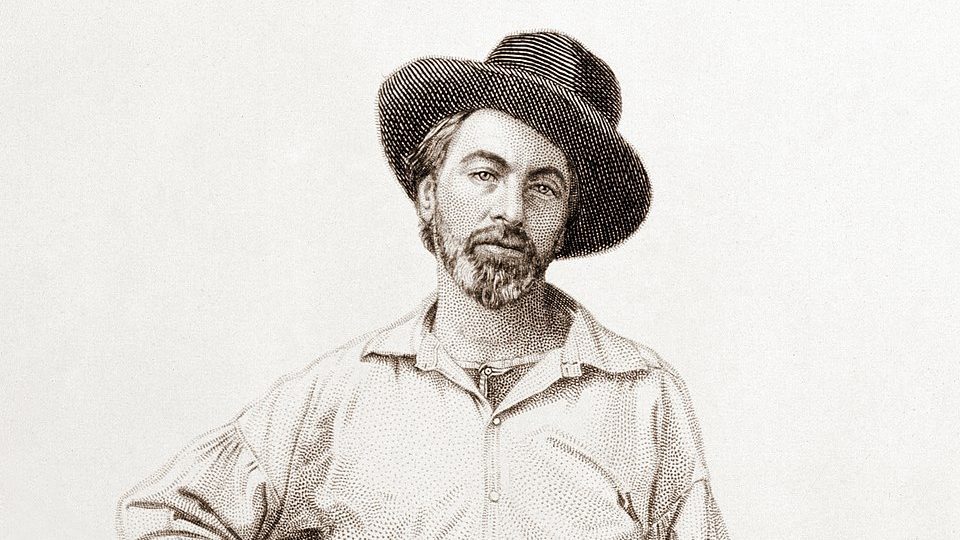
Walt Whitman (1819–1892) was an American poet whose ever-expanding masterwork, Leaves of Grass, broke open the possibilities of poetry and helped invent a distinctly American voice. Writing in sprawling, unrhymed free verse, he sang of democracy, the body, the self, and the unity of all living things — and reshaped what a poem could be.
Largely self-taught and rooted in the working life of Brooklyn and Long Island, Whitman spent nearly four decades revising a single book, growing it edition by edition into a lifelong record of his vision of America. Controversial in his day for its frankness, his work is now seen as one of the foundations of modern poetry.
On This Page: Early Life and Education · Literary Career and Major Works · Style and Themes · Later Life and Legacy · Notable Poems · Frequently Asked Questions · Related Poets
Early Life and Education
Whitman was born on May 31, 1819, into a large working-class family on Long Island and grew up largely in Brooklyn, leaving public school around the age of eleven to help support the household.
He worked as a printer’s apprentice, a country schoolteacher, and a journalist and editor — trades that steeped him in the rhythms and idioms of ordinary American life. Though his formal education was brief, he read voraciously, absorbing the Bible, Shakespeare, and above all the Transcendentalism of Ralph Waldo Emerson, whose faith in the divinity of the individual and the unity of nature and spirit became the bedrock of Whitman’s art.
Literary Career and Major Works
Whitman’s reputation rests on a single book that he never stopped rewriting. In 1855 he self-published the first edition of Leaves of Grass, a thin volume of twelve untitled poems led by the work later called “Song of Myself.” Its long, unrhymed lines, sweeping catalogs, and frank celebration of the body scandalized some readers and electrified others — Emerson wrote to greet him “at the beginning of a great career.”
Over the next four decades, Whitman revised and enlarged the book through edition after edition, turning it into a lifelong project. His service as a volunteer nurse in Civil War hospitals deepened his work, producing the sorrowing war poems of Drum-Taps (1865) and his great elegies for the assassinated Abraham Lincoln.
Style and Themes
Whitman threw out the rulebook of nineteenth-century verse. Abandoning rhyme and fixed meter, he wrote in long, rolling free-verse lines built on repetition and the accumulating “catalog” — a music closer to oratory and scripture than to traditional poetry.
His subjects were vast and inclusive: democracy, the equal worth of every person, the sacredness of the body and sexuality, nature, death, and the deep connection binding all things and beings. He cast the poet as a representative voice, an “I” that contains multitudes and speaks for the whole nation. That fusion of the personal and the collective is the signature of his work.
Later Life and Legacy
A stroke in 1873 slowed but never stopped him. Whitman moved to Camden, New Jersey, where he lived simply and kept revising, issuing the final “deathbed edition” of Leaves of Grass in 1891–92.
He died in Camden on March 26, 1892, at seventy-two. His influence has only grown: his free verse and democratic, all-embracing vision run straight through American poetry — from Langston Hughes and Allen Ginsberg to poets writing today, and outward to figures like Pablo Neruda abroad. He is remembered as the poet who gave the United States its most expansive literary mirror.
Notable Poems
These are the Whitman poems most worth starting with:
- Song of Myself: The sprawling centerpiece of Leaves of Grass — an exuberant, all-embracing celebration of the self, the body, and democratic America.
- O Captain! My Captain!: His most popular poem, an elegy for the assassinated Abraham Lincoln cast as a sea captain who dies as his ship reaches port.
- When Lilacs Last in the Dooryard Bloom’d: A second, greater Lincoln elegy that weaves lilac, star, and birdsong into one of the finest elegies in English.
- I Sing the Body Electric: A frank, ecstatic hymn to the human body as something sacred.
- Out of the Cradle Endlessly Rocking: A seashore reverie in which a boy’s brush with a bird’s grief awakens his vocation as a poet.
- A Noiseless Patient Spider: A short, exquisite lyric likening the soul’s reach for meaning to a spider casting filaments into the void.
Frequently Asked Questions
Quick answers to the questions readers most often ask about Walt Whitman.
What is Walt Whitman best known for?
His landmark collection Leaves of Grass, and especially “Song of Myself.” He is regarded as the father of free verse and one of the founders of modern American poetry.
What is Leaves of Grass?
Whitman’s life’s work: a single collection of poems he first self-published in 1855 and then revised and expanded for the rest of his life, ending with the 1891–92 “deathbed edition.”
Why is Walt Whitman important?
He broke poetry free of rhyme and strict meter, pioneering free verse, and gave voice to a democratic, inclusive vision of America and the self that reshaped modern poetry.
What are the main themes in Walt Whitman’s poetry?
Democracy and equality, the self, the human body and sexuality, nature, death, and the spiritual unity of all living things.
Did Walt Whitman serve in the Civil War?
He didn’t fight, but he volunteered as a nurse in Washington’s military hospitals — an experience that shaped his war poems in Drum-Taps and his elegies for Abraham Lincoln.
Related Poets
Readers who admire Whitman often turn to these poets:
- Emily Dickinson: His great American contemporary and the other founder of modern American poetry — private and compressed where Whitman is public and expansive.
- Ralph Waldo Emerson: The Transcendentalist whose essays gave Whitman his philosophical springboard — and who hailed Leaves of Grass on first reading.
- Langston Hughes: A Harlem Renaissance poet who inherited Whitman’s democratic, inclusive vision and his ear for the American vernacular.
- Allen Ginsberg: The Beat poet whose long-lined, barbaric-yawp catalogs are unthinkable without Whitman.
- Robert Frost: Another foundational American voice, though formally traditional where Whitman runs free.